Stone aggregate — the checks nobody does (and should)
Aggregate is ~70% of your concrete by volume, and it has quality rules like everything else: correct size for the job (20mm for most structural work), angular and cubical rather than flaky, hard parent stone, and — above all — clean. Dust-coated or mud-contaminated aggregate weakens the cement bond exactly like silty sand does.
Concrete is a fruit cake — cement paste is the batter, aggregate is the fruit. Dusty fruit never binds into the cake; it just sits there, waiting to fall out.
Stone aggregate, the crushed stone chips that go into concrete, makes up roughly 60 to 75 percent of its volume. It is the skeleton of the concrete: the cement paste only glues the pieces together. Yet on most sites it is the least checked material of all. Cement comes in branded bags with dates, steel comes with mill certificates, and aggregate arrives as a heap tipped from a truck, accepted on sight.
Good aggregate is hard, clean, of the right size and shape, and free of soil, dust and soft stone. This guide explains what each of those means and why it matters, what the Indian standard asks, the stone sold around Kolkata, a two-minute check at delivery, the laboratory tests worth asking for, storing and measuring it on site, and what to do with a doubtful load.
What aggregate does in concrete
Concrete is a packed mass of stone and sand bound by cement paste. The coarse aggregate takes most of the volume and much of the load, the sand fills the gaps between the stones, and the paste coats every particle and fills what is left. The better the stones pack together, the less paste is needed to fill the gaps, and the less water the mix needs for the same workability. Less water means stronger, denser concrete.
Each property of the aggregate affects that. Dust and clay coat the stones, so the paste cannot grip them, and they soak up water that would otherwise go to the cement. Flaky, elongated pieces pack badly and need more paste. Soft or weathered stone breaks under load and lets water through. A load that is the wrong size will not pass between the bars or fill the corners of the formwork.
What the Indian standard asks
IS 383:2016 sets the requirements for aggregates for concrete. It asks for aggregate made from naturally hard, strong, dense and durable stone, free of coatings and of harmful material such as clay lumps, coal, soft fragments and excess fine dust. It limits the combined flakiness and elongation index of crushed coarse aggregate to 40 percent, and sets limits for strength tests and for the grading of each size. The tests themselves are in IS 2386.
IS 456 adds the rule for size: the largest stone should be as large as the work allows, but no more than a quarter of the thinnest part of the member, and small enough to pass between the bars and round them. For most reinforced work, 20 mm aggregate suits; 10 mm suits thin sections and closely spaced bars; 40 mm and larger suits mass concrete with no bars in the way.
| Size | Usually used for |
|---|---|
| 10 mm | Thin slabs and toppings, closely spaced bars, small precast work |
| 20 mm | Most reinforced concrete: footings, columns, beams, slabs |
| 40 mm | Plain concrete beds, mass concrete, roads |
| Graded 20 mm and 10 mm together | A better-packed mix, as the mix design asks |
The stone sold around Kolkata
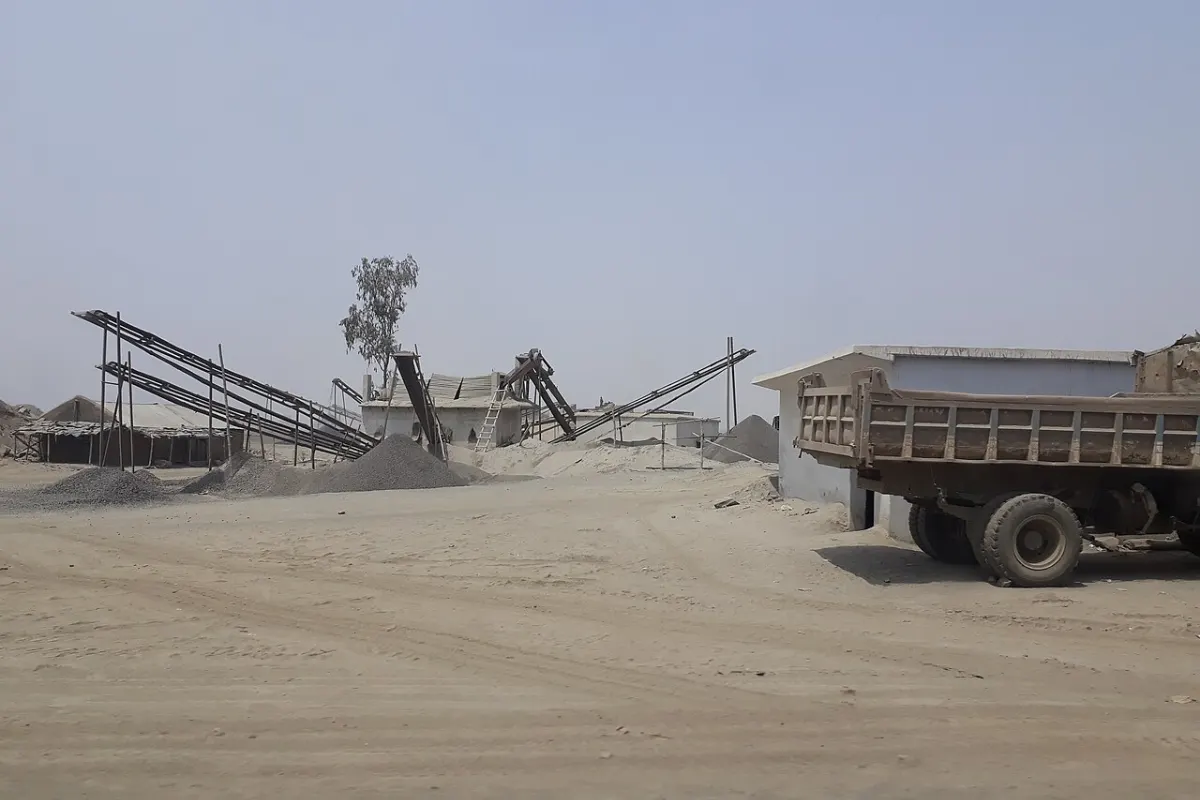
Kolkata has no hard rock of its own: the city sits on deep river silt and clay. Most crushed stone sold here comes from the quarries and crushers of the basalt and granite belts to the west and north-west, in Birbhum and in the Pakur area of Jharkhand, and is sold as stone chips by size. Good basalt chips are dark, hard and dense, and make strong concrete when they are clean and well shaped.
Two other materials are common on local sites. Brick aggregate, broken overburnt brick called khoa, is still used in lean concrete beds and in roof terracing in old houses, but it is porous and weak, and is not for reinforced concrete. River gravel, rounded and smooth, makes workable concrete but grips the paste less well than crushed stone; it should not be supplied where crushed stone was specified.

The two-minute delivery check
Most problems with aggregate can be seen at the gate. Make this check before the truck is unloaded onto your heap, while there is still a choice.
- Watch the truck tip: a cloud of dust means a heavily coated load.
- Rub a handful between your palms: a coat of fine dust left on the skin means the load needs washing or rejecting.
- Look at the shape: chunky, angular pieces are good; many thin, flat or long pieces are not.
- Look at the size: a 20 mm load should not be full of 40 mm stones or of fine grit.
- Look for soil, brick pieces, leaves, roots, coal or soft, crumbly, rust-brown or layered stones.
- Tap a few pieces together or with a hammer: hard stone rings and stays whole; weak stone crumbles or splits.
- Shake a handful in a clear bottle of water and let it stand: thick muddy water, or a layer of silt on top of the stones, means the load is dirty.
- Measure the truck body, length by width by depth of the load, to check the volume you are paying for.
A heap on the ground always looks bigger than it is. Check the volume in the truck before it is tipped, and keep the challan with the date, the size and the source.
Tests worth asking for
For a house, the delivery check and a reliable supplier are usually enough. For larger pours, a new source, or concrete of a higher grade, ask for laboratory results, or send a sample yourself. The tests are standard, quick and inexpensive.
| Test | What it shows |
|---|---|
| Sieve analysis | Whether the sizes are graded as ordered, and the share of dust |
| Flakiness and elongation | How much of the load is flat or long |
| Crushing and impact values | How strong and tough the stone is; IS 383 sets tighter limits for floors and pavements |
| Water absorption and specific gravity | How dense the stone is; porous stone weakens concrete |
| Deleterious materials | Clay lumps, soft pieces, coal and fine dust |
| Soundness and alkali reactivity | For unknown sources: whether the stone weathers or reacts with cement |
Storing and measuring it on site
A good load can be spoiled on site in a day. Aggregate tipped on bare earth picks up mud at the bottom of the heap, which then goes into the mixer with every shovel from the base.
- Stack each size separately on a hard, clean base: a brick-on-edge or concrete pad, or at least a cleared, compacted area with the bottom layer left unused.
- Keep heaps away from soil, sand and debris, and stop vehicles driving over them.
- Cover them from leaves and dust where trees or roads are close.
- In the monsoon, let wet heaps drain, and allow for the water they carry when the mix is batched.
- Measure by gauge boxes of a known volume, or by weight, never by the shovel or the basket count alone.
- Use the oldest heap first, and do not top up a dirty heap with a clean load.
When a load is doubtful
- Dusty but otherwise sound: wash it on a hard base with clean water before use, and let it drain.
- Too many flaky or long pieces: reject it for structural concrete; it may do for non-structural work.
- The wrong size: reject it, or use it only where that size is allowed.
- Soil, brick or soft stone mixed in: reject it.
- Rounded gravel instead of crushed stone: ask the engineer before using it; the mix may have to change.
- In any doubt for a structural pour: keep the load aside and send a sample for testing.
Recycled and other aggregates
IS 383:2016 also allows aggregates made from recycled concrete and from some industrial slags, within set limits and for set uses. They help reduce quarrying and waste, but their quality varies with the source, and their use in reinforced concrete is limited. Ask your engineer before any of them goes into structural work, and ask for test results from the supplier.
What this means for your concrete
Aggregate is the one material in concrete that nobody bags or certifies on a small site, so its quality depends on the supplier and on who checks it at the gate. On our sites we buy by source, not by truck: one visit to a crusher shows how the stone is quarried, crushed, screened and washed, and tells us more than any number of deliveries. Our Slab Concrete Calculator works out the quantities of cement, sand and aggregate for a slab, so you can check what is ordered against what the work needs.
Delivery checks in two minutes
- Rub a handful: palms coated in fine dust = wash it or reject it.
- Look for flaky, elongated chips — they interlock poorly; good aggregate is chunky and angular.
- Uniform size per the order — a '20mm' load full of 40mm boulders won't pass between rebar.
- No soil, leaves or brick waste mixed in from a dirty stockpile.
Questions people ask
Which aggregate size should be used for a house?
For most reinforced concrete, 20 mm crushed stone, or 20 mm and 10 mm graded together as the mix design asks. Use 10 mm for thin sections and closely spaced bars, and 40 mm only where there are no bars in the way.
How can you tell if aggregate is too dusty?
Rub a handful between your palms. If a coat of fine dust stays on the skin, or a handful shaken in a bottle of water leaves it thick and muddy, the load needs washing before use, or rejecting.
Can brick aggregate be used in slabs?
Not in reinforced concrete. Broken brick is porous and weak. It is used in lean concrete beds and roof terracing, but structural concrete needs hard crushed stone.
Is river gravel as good as crushed stone?
Rounded gravel makes workable concrete but grips the cement paste less well. Use it only where the engineer allows it, and never as a silent substitute for crushed stone.
Do you need to test aggregate for a small building?
A careful delivery check and a reliable source are usually enough. For larger pours, higher grades or a new source, laboratory tests under IS 2386 are quick and well worth it.
How should aggregate be stored?
On a hard, clean base, with each size in its own heap, away from soil and debris, and covered where dust or leaves can fall on it.
Red flags
- Aggregate dumped on bare earth and shovelled up with the mud
- Visible dust cloud when the truck tips — heavily coated material
- Rounded river shingle supplied where crushed stone was specified
Pro tip
Our supply arm buys aggregate by source, not by truck — one crusher visit tells you more than ten deliveries.
Work it out: Slab Concrete Calculator
Sources
- IS 383:2016 Coarse and Fine Aggregate for Concrete, Specification (Bureau of Indian Standards) (checked 15 Nov 2026)
- IS 2386 Methods of Test for Aggregates for Concrete (Bureau of Indian Standards) (checked 15 Nov 2026)
- IS 456:2000 Plain and Reinforced Concrete, Code of Practice (clause 5.3) (Bureau of Indian Standards) (checked 15 Nov 2026)
- IS 4082:1996 Stacking and Storage of Construction Materials and Components at Site (Bureau of Indian Standards) (checked 15 Nov 2026)
Checked against these sources on the dates shown, pending our team’s sign-off.