Borewells & groundwater — what to know before you drill
Three things decide a borewell's success: the aquifer under your plot (a hydrogeological assessment or nearby borewell data beats guesswork), legal clearance (many municipal areas including Kolkata require permission for new borewells), and construction quality — proper casing depth to seal out contaminated shallow water. Budget for the drilling AND the pump, wiring, and a recharge pit — extraction without recharge is borrowing from a falling account.
A borewell is a straw into a shared glass — everyone's straw draws from the same water table. Recharge pits are how you top the glass back up.
Many houses in and around Kolkata still draw water from the ground, either as the main supply where the municipal line is weak or as a backup when the tap runs dry. A borewell looks simple: a hole, a pipe and a pump. In practice its success depends on what lies under your plot, on whether you are allowed to drill there, and on how well the well is built and sealed. A badly built borewell can draw polluted shallow water, choke with sand within a few years, or put you on the wrong side of the state's groundwater law.
This guide explains how groundwater sits under Kolkata, what the West Bengal groundwater law asks of you, how a borewell is built and what to check while it is drilled, water quality and the arsenic question, pumps and yield, recharge, and the warning signs in a drilling quote. Our Water Check in the Lab reads a water test report against the drinking water standard.
How groundwater sits under Kolkata
Kolkata stands on the deposits of the Ganga delta: layer upon layer of clay, silt and sand laid down by rivers over thousands of years. Near the surface there is usually a cap of soft clay and silt. Below it lie beds of sand that hold water, the aquifers, separated in places by more clay. The thickness and depth of each layer change from one part of the city to another, and sometimes from one street to the next.
Water in the shallow layers is the easiest to reach and the easiest to pollute. Drains, septic tanks, soak pits, ponds and old landfill all leak into it. The deeper sands, sealed below thick clay, usually hold cleaner water, and a well that draws only from them, with the shallow layers shut out, is the safer well. Heavy pumping across the city has lowered groundwater levels in many areas over the past decades, which the Central Ground Water Board tracks through its monitoring wells. Local knowledge matters: the depths and yields of working wells near you, and the driller's log of what came up from your own hole, are the best guides you will have.
The law: a permit before you drill
West Bengal regulates groundwater under the West Bengal Ground Water Resources (Management, Control and Regulation) Act, 2005, and its rules of 2006. The State Water Investigation Directorate runs the system. Anyone who wants to sink a well fitted with a mechanical or electrical pump has to apply for a permit first: to the District Level Authority, or in and around Kolkata to the Corporation Level Authority, with the largest draws going to the State Level Authority. Before granting a permit, the authority looks at the water balance of the area and the quality and quantity of water available.
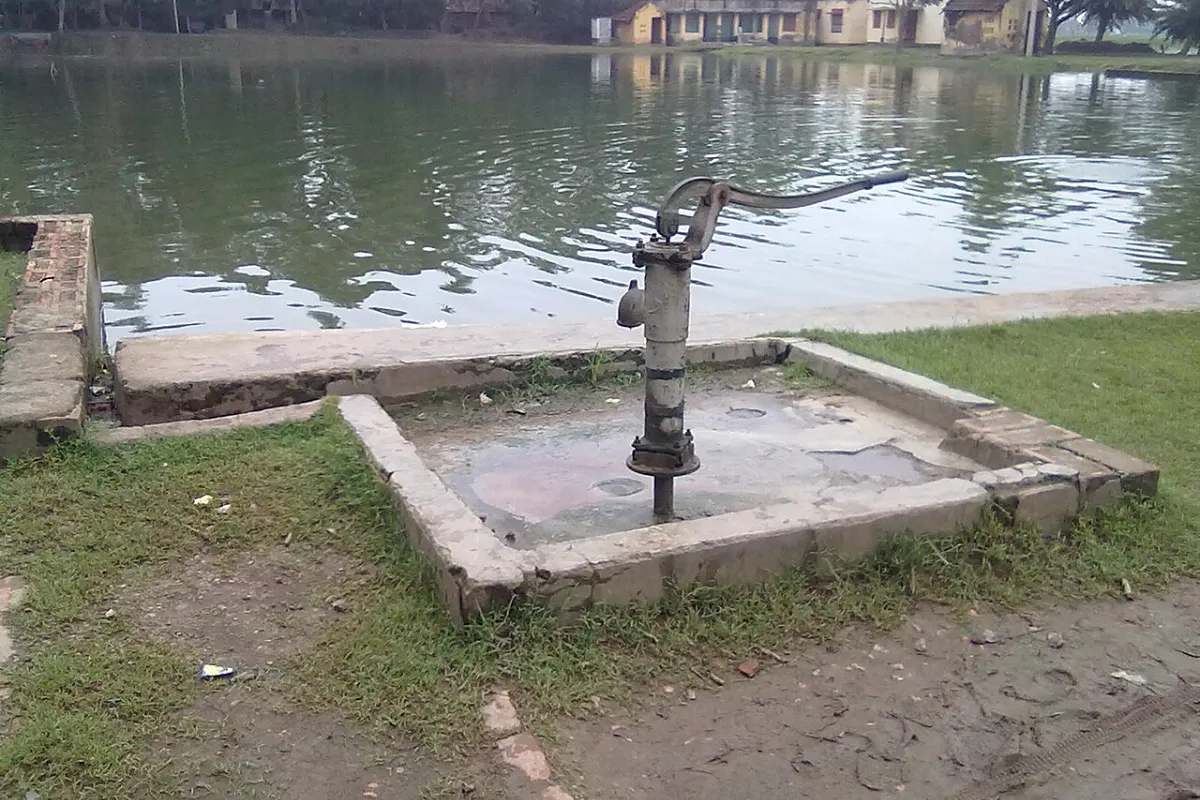
Tube wells fitted with a hand pump, and wells worked without any mechanical or electrical device, are outside the permit rule. Wells sunk before the Act came into force have to be registered. The authorities can inspect wells, fit meters, test the water, and seal a well that was sunk without a permit or draws more than it should. Your municipality may add its own conditions, and building rules increasingly expect rainwater to be harvested on the plot.
Drilling first and asking later is a real risk. A well sunk without a permit can be sealed, and the money spent on it is lost. We check the permit position before any drilling rig arrives.

How a borewell is built
- Choose the spot: as far as the plot allows from septic tanks, soak pits, drains and old ponds, where a rig can reach and the pump can be serviced later.
- Get the permit, with the depth, diameter and pump size the application asks for.
- Drill the hole. In Kolkata's soft ground this is usually done by rotary drilling with a mud that holds the hole open and carries the cuttings up.
- Log the layers: the driller keeps samples of what comes up every few metres, in order, so you can see where the clay ends and the water-bearing sand begins.
- Lower the pipes: plain casing pipe through the shallow layers and the clay, and a slotted screen pipe set against the chosen sand layer. Casing and screen pipes in uPVC are made to IS 12818.
- Pack the space around the screen with graded gravel, which lets water in and keeps sand out.
- Seal the space around the casing above the gravel with clay or cement grout, so that shallow water cannot run down the outside of the pipe into the aquifer, and finish the top with a sealed cap and a concrete platform.
- Develop the well: pump or blow air through it until the water runs clear and free of sand.
- Test the yield and the water quality before choosing and fixing the pump.
What to check while it is drilled
- A written specification before work starts: the planned depth, casing and screen material and diameter, screen slot size, gravel pack and seal.
- The driller's log and the sample bags, laid out in order, so the depth of the screen can be judged against the sand layers actually found.
- The length of casing and screen going down, counted pipe by pipe as each one is joined and lowered.
- The seal around the casing at the top: without it, the well can draw polluted surface water whatever its depth.
- Development until the water is clear: a well handed over still cloudy or sandy will wear out its pump.
- A yield test, pumping at a steady rate and watching how far the water level drops and how fast it recovers.
- A record of everything, kept with the house papers: the log, the depths, the pipes, the yield, the permit and the first water test.
Water quality and the arsenic question
Arsenic in groundwater is a known problem in parts of West Bengal, mostly in the shallow aquifers of the delta districts, including parts of North and South 24 Parganas and areas on the fringes of Kolkata. Arsenic has no colour, taste or smell, and harm builds up over years of drinking. Deeper aquifers sealed below clay are usually lower in arsenic, but not always, and the picture can change as heavy pumping draws water from other layers.
Other common problems are iron, which stains buckets and tiles red-brown and gives a metallic taste; hardness, which leaves white scale on taps and geysers; salinity in some southern areas; and bacteria, from sewage reaching a shallow or badly sealed well. None of these can be judged by looking at the water. The Indian drinking water standard is IS 10500; a test from an accredited laboratory, against that standard, is the only way to know what you are drinking.
- Test before anyone drinks the water, and again after the first monsoon.
- Test every year after that, and whenever the colour, taste or smell changes.
- Choose treatment to match the test: an iron removal filter for iron, an arsenic removal unit for arsenic, disinfection for bacteria. A reverse osmosis unit is not the answer to every problem, and it wastes a large share of the water it treats.
- Keep drinking water and other water separate if only the drinking water is treated.
Pumps, yield and running
The pump should be chosen after the yield test, not before. A pump larger than the well can supply draws the water level down to the screen, sucks in sand, and burns out early. Submersible pumps, which sit down inside the well, are the usual choice for deeper wells; surface pumps suit only shallow water levels. The pump also has to lift the water to wherever it goes, a sump or a roof tank, and that height is part of its sizing.
A borewell usually fills a sump or an overhead tank rather than feeding taps directly, so the pump runs for set periods instead of starting every time a tap opens. Dry-run protection stops the pump when the water runs out. The wiring and starter need proper earthing and protection under the Central Electricity Authority's safety regulations. Our Water Tank Sizing tool works out the tank sizes, pump head and fill time for your household.
Recharge: putting water back
Every borewell takes from a shared store. Recharge puts some of it back. The usual way is to lead rooftop rainwater, through a first-flush device and a filter, into a recharge pit or recharge well. Roof water is the right source; water from roads, drains and courtyards carries oil, waste and germs into the very aquifer you drink from.
Kolkata's clay makes recharge harder: a shallow pit dug into clay soaks away slowly. Recharge wells or shafts that reach down to a sand layer work better. The Central Ground Water Board publishes guidance on artificial recharge, and our Rainwater Harvesting tool sizes a sump and recharge pit for your roof.
Warning signs in a drilling quote
- A price per foot of depth with nothing written about the casing, screen, gravel pack or seal.
- No mention of the permit, or an offer to drill without one.
- A promise of a depth or a yield before anyone has looked at the ground.
- No driller's log, no samples, and no yield test at the end.
- A pump chosen before the well is drilled and tested.
- Drinking water planned with no water test.
When a well is no longer used
An unused borewell must be sealed properly, not left with a loose cap or a few bricks over the hole. Open borewells have caused deaths of young children across India, and the Supreme Court has issued safety directions for wells that are abandoned or left unattended. Sealing also stops surface water running straight down into the aquifer. Fill and seal the well from the bottom up, cap it, and record where it was.
Questions people ask
Do you need permission to drill a borewell at home in West Bengal?
Yes, if the well will be fitted with a mechanical or electrical pump. The permit comes from the District Level Authority, or the Corporation Level Authority in and around Kolkata, under the West Bengal Ground Water Resources Act, 2005. A tube well with a hand pump does not need a permit.
How deep should a borewell be in Kolkata?
There is no single answer. The depth is set by where a good, clean sand layer lies below the clay at your plot, which the driller's log and nearby working wells show. Any quote that promises a depth before drilling is guessing.
Is borewell water safe to drink?
Only a laboratory test against IS 10500 can tell you. Arsenic, iron, salinity and bacteria are all possible around Kolkata, and arsenic gives no sign in the glass. Test before drinking, after the first monsoon and every year.
Why does borewell water stain buckets and tiles red?
That is iron dissolved in the groundwater, which turns red-brown when it meets air. It is common around Kolkata. An iron removal filter, chosen after a test, usually solves it.
Does a recharge pit really help?
It puts rooftop rainwater back into the ground instead of the drain. In clayey ground a recharge well that reaches a sand layer works much better than a shallow pit. Only roof water should go into it, never water from roads or drains.
What should be done with an old borewell?
Seal it properly from the bottom up and cap it. An open or loosely covered borewell is a danger to children and lets surface water pollute the aquifer.
Red flags
- Drilling contractor who quotes per-foot with no casing specification
- No permission check in a regulated municipal area
- Drinking use planned with no water quality test
Pro tip
We handle borewell permissions, drilling supervision and recharge pit design as part of site development — one accountable scope, not three vendors.
Try it in our Lab: Water Check
Sources
- West Bengal Ground Water Resources (Management, Control and Regulation) Act, 2005, and Rules, 2006 (checked 15 Nov 2026)
- Government of West Bengal: the Ground Water Resources Act, permits and fees (State Water Investigation Directorate) (checked 15 Nov 2026)
- Central Ground Water Board: groundwater levels and artificial recharge guidance (checked 15 Nov 2026)
- IS 10500:2012 Drinking Water, Specification, and IS 12818 uPVC Casing and Screen Pipes (Bureau of Indian Standards) (checked 15 Nov 2026)
Checked against these sources on the dates shown, pending our team’s sign-off.