Kitchen countertops — granite, quartz or solid surface
The three mainstream choices. Granite is natural stone: hard, heat-tolerant, cheap-to-mid priced, but with visible seams and joints that need periodic sealing. Engineered quartz is crushed stone bound in resin: non-porous, stain-resistant, uniform-looking, pricier, but not as heat-proof (don't rest a hot pan on it). Solid surface (acrylic) is seamless and repairable but the softest and least heat-tolerant. For most Indian kitchens with hot vessels, granite or quartz win.
Granite is solid wood — natural, tough, each piece unique, needs occasional oiling. Quartz is high-quality engineered board — flawlessly uniform and low-maintenance, but you respect its limits (heat). Solid surface is the softest, most forgiving-to-repair option.
A kitchen counter in an Indian home works hard. Hot kadais come straight off the flame, turmeric and oil splash, lemon and tamarind drip, the pressure cooker hisses every day, the grinder rattles, and water stands around the sink. The material you choose has to stand up to how you actually cook. And whatever the material, the way it is cut, supported and joined decides whether it cracks at the sink in its second year.
This guide compares the common materials, from granite and engineered quartz to solid surface, marble, Kota stone, stainless steel and porcelain slabs, then explains the platform that holds the counter up, the details at cut-outs, edges and joints, a word on the safety of the workers who cut stone, the checks at installation, and how to look after each material. Our kitchen guide covers the layout and the work triangle.
What a kitchen counter has to survive
- Heat: hot vessels set down straight from the burner, and the hob's heat around its cut-out.
- Stains: turmeric, oil, tea and masala.
- Acids: lemon, tamarind, vinegar and tomato, which etch some stones.
- Knocks and weight: heavy vessels, the grinder and the pressure cooker.
- Water: standing water around the sink, and wet cleaning every day.
- Cleaning: scrubbing and household cleaners, some of them strongly alkaline or acidic.
The materials compared
| Material | Strong points | Watch for |
|---|---|---|
| Granite | Hard, takes heat well, wide choice, widely available | Lighter stones are porous and need sealing; visible seams; some black granite is dyed |
| Engineered quartz | Non-porous, resists stains, uniform look, no sealing | Resin can scorch with hot vessels; some colours yellow in sunlight; dust hazard when cut |
| Solid surface (acrylic) | Seamless joints and sinks, scratches can be sanded out | Softest; marks with heat and knives |
| Marble | Beautiful, cool | Acids etch dull spots; stains easily; scratches |
| Kota and other limestones | Inexpensive, traditional, durable underfoot | Porous; stains and etches with acids |
| Stainless steel | Heat-proof, hygienic, easy to clean | Scratches and dents; looks institutional to some |
| Porcelain or sintered slabs | Resist heat, stains and acids | Thin edges chip; need skilled cutting and full support |
Granite
Granite is a natural stone formed from cooled molten rock, mostly hard minerals that resist scratching and heat. It is the most common counter in Kolkata kitchens, from Indian quarries in the south and in Rajasthan. Dark, polished granites hide stains well; lighter granites are more porous and should be sealed, or oil and turmeric soak in. Each slab is different, so choose the actual slab, not a sample, and look at it in daylight.
Look for natural fissures and cracks, some of which are filled with resin at the factory; a filled crack near a cut-out can open. Some black granite is dyed to deepen its colour: rubbing a hidden spot with a cloth dampened with acetone or nail polish remover shows it, as the dye comes off on the cloth. IS 14223 (Part 1) covers polished granite for building.
Engineered quartz
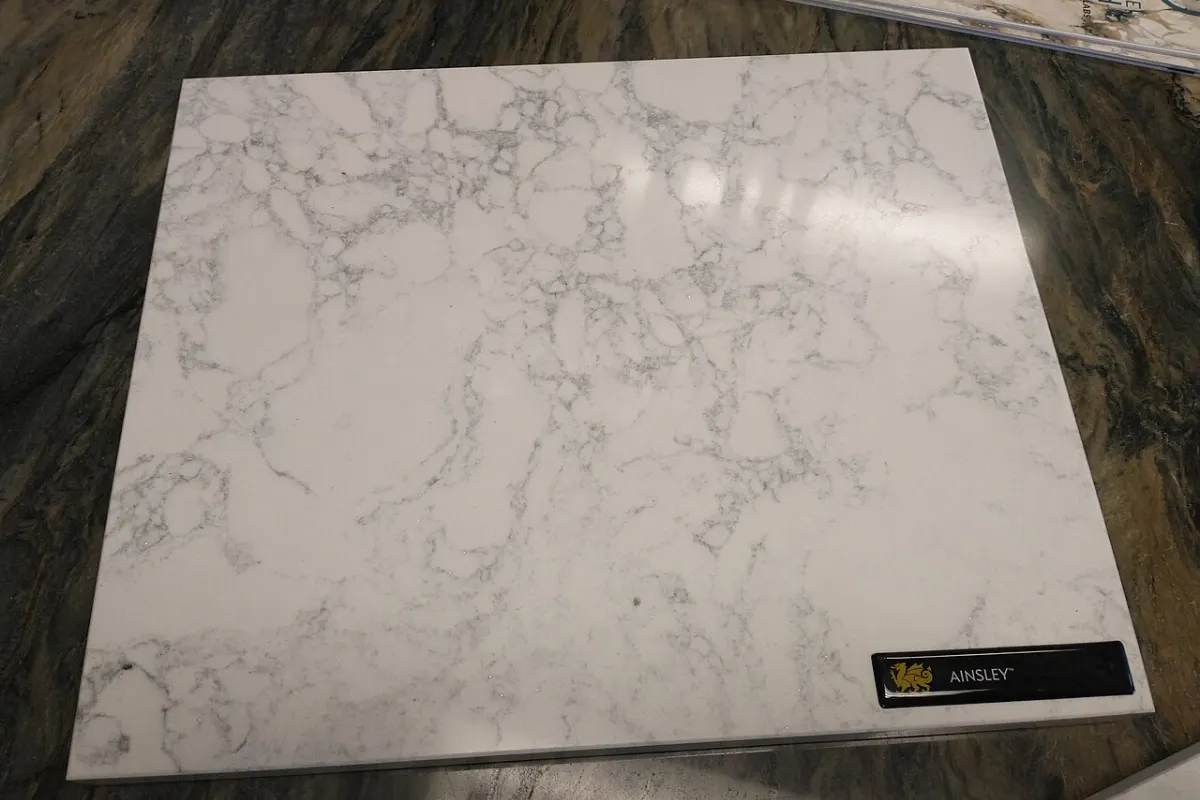
Engineered quartz is crushed quartz bound with resin, typically about nine parts stone to one part resin and pigment, pressed into slabs. It is non-porous, so it resists stains without sealing, and it looks the same from one end to the other. Its weak point is the resin. A vessel straight from the flame can scorch or crack it, so trivets are a must, and some lighter colours yellow over time near a sunny window. Damage is harder to repair invisibly than on natural stone.

A word on the workers who cut stone
Cutting and polishing engineered quartz, and to a lesser degree granite, releases fine dust of crystalline silica. Breathed in over time, it causes silicosis, a lung disease with no cure, and engineered stone, with its very high silica content, is the worst offender. Australia banned engineered stone benchtops from July 2024 for this reason. Once installed, the counter is no danger in your kitchen. The risk is to the people who cut it. Ask for the slab to be cut and finished at the fabricator's workshop with water and dust control, and do not allow dry cutting of stone inside your home.
Solid surface, marble and others
Solid surface counters are made of acrylic or polyester resin with mineral filler. Their joints can be made almost invisible, and sinks can be formed in one piece with the counter. Scratches and small burns can be sanded out, but they mark more easily than stone, and hot vessels must never go straight onto them.
Marble and Kota stone are calcium carbonate, which acids attack. Lemon juice or tamarind left on them etches a dull spot, and oil and turmeric stain. They were common in older Kolkata kitchens, often as a Kota or similar stone top on a brick platform, and they serve well with care. Stainless steel is the professional kitchen's choice for good reasons. Porcelain and sintered slabs resist almost everything a kitchen can throw at them, but they are thin and brittle at the edges, and need skilled fabrication and full support.
The platform under the counter
In many Indian kitchens the counter sits on a built platform: a thin concrete or stone slab carried on brick or block supports, with the stone top laid over it. In modular kitchens it sits on the cabinets, usually with a board or frame beneath. Either way, the stone must be supported evenly. A slab bearing on a few points, or over hollow spots, cracks when the grinder runs or a heavy vessel lands on it.
Common working heights are about 850 to 900 mm, and depths about 600 mm, adjusted for the person who cooks most. The cabinet under the sink needs a waterproof base and ventilation, because a slow leak under a sink rots boards and rusts hardware out of sight.
Cut-outs, edges and joints
- Sink and hob cut-outs with rounded inside corners: a sharp corner is where cracks start.
- Enough stone left in front of and behind each cut-out, never a narrow strip at the front edge.
- Reinforcing rods set into the underside around cut-outs where the fabricator recommends them, especially in long, narrow pieces.
- An undermounted sink held by brackets or clips fixed to the stone or cabinet, not by adhesive alone.
- Clearance around the hob as its maker asks, so heat does not crack the stone or scorch the resin.
- Overhangs, such as a breakfast counter, supported by brackets when they extend beyond a short distance.
- Edges eased or rounded rather than left sharp, so they chip less.
- Joints placed away from the sink and hob, tight and colour-matched, and the counter sloped very slightly so water runs to the sink.
- The joint between the counter and the wall tiles sealed with a flexible silicone sealant.
Checks at installation
- See the actual slab before it is cut, and check it for cracks, filled fissures, colour and finish.
- Make sure the template is taken from the finished cabinets or platform, not from the drawing.
- Check the counter is level with a spirit level, and that it sits evenly on its support everywhere, with no rocking.
- Look closely at every cut-out corner for hairline cracks.
- Check the seams: tight, flat to the touch and matched.
- Check the sink support and the silicone around it from underneath.
- Pour water on the counter and watch it run to the sink, with nothing pooling or seeping into joints.
- For granite and marble, confirm that it was sealed, and note the product used.
Looking after each one
- Granite: wipe up spills; reseal when a drop of water darkens the stone instead of beading on it.
- Quartz: use trivets for hot vessels, and avoid harsh alkaline cleaners and scouring powder.
- Marble and Kota: wipe up lemon, tamarind and other acids at once; seal regularly; use mild cleaners.
- Solid surface: never put hot vessels on it; sand out light scratches as the maker advises.
- Every material: use a chopping board, and never place a hot pressure cooker straight on a resin-based top.
Match to how you cook
| Granite | Quartz | Solid surface | |
|---|---|---|---|
| Heat | Excellent | Moderate (use trivets) | Poor |
| Stains | Needs sealing | Highly resistant | Resistant |
| Look | Natural, varies, visible seams | Uniform, many colours | Seamless |
| Cost | Low-mid | Mid-high | Mid |
The detail that ruins good stone
A cheap or poorly-supported countertop cracks at the sink and hob cut-outs — the weakest points. Insist on proper support brackets under the stone at cut-outs and overhangs, and a clean, well-matched seam. The material rarely fails; the fabrication and support do.
Questions people ask
Which countertop suits Indian cooking best?
For most kitchens with hot vessels and strong spices, granite or engineered quartz. Granite takes heat better; quartz resists stains better but needs trivets. A darker granite is the most forgiving all-rounder.
Is quartz heat-proof?
No. The resin that binds it can scorch or crack under a vessel straight from the flame. Always use a trivet.
How can you tell if black granite has been dyed?
Rub a hidden spot with a cloth dampened with acetone or nail polish remover. If colour comes off on the cloth, the stone has been dyed.
Why did the granite crack near the sink?
Usually because of a sharp-cornered cut-out, too little stone left beside it, uneven support underneath, or a heavy knock on a weak spot. The fabrication and support decide this more than the stone.
Does granite need sealing?
Lighter, more porous granites do, and should be resealed from time to time. If a drop of water darkens the stone rather than sitting on top, it is time.
Is engineered stone safe to have at home?
Once installed, yes. The danger is silica dust when it is cut, which harms the workers. Insist that cutting is done at the workshop with water and dust control, never dry in your home.
Red flags
- No support under a stone overhang or at cut-outs
- A hot-pan habit planned on quartz or solid surface
- Visible mismatched or wide seams on granite
Pro tip
Countertop choice is about how you actually cook, not just the showroom look. Our interiors team matches material to your kitchen use and gets the fabrication and support details right — where most failures actually start.
Sources
- NKBA Kitchen and Bath Planning Guidelines (checked 15 Nov 2026)
- IS 14223 (Part 1) Polished Building Stones: Granite, Specification (Bureau of Indian Standards) (checked 15 Nov 2026)
- Safe Work Australia: the prohibition on engineered stone (from 1 July 2024) and silica dust (checked 15 Nov 2026)
Checked against these sources on the dates shown, pending our team’s sign-off.