The Curing Clock — how strong is my slab today?
An interactive strength curve: slide to the age of your freshly cast slab and see roughly what share of its design strength it has earned, what's safe to do at that stage, and when props can come off.
Concrete does not become strong on a fixed day. From the moment water meets cement it starts to gain strength, quickly in the first days and then more slowly, for months. The Curing Clock in our Concrete Lab draws that curve for a slab: slide to its age and see roughly what share of its design strength it has earned, what is usually safe to do at that stage and when the props can come out.
This guide explains what sits behind the curve and the site decisions it helps with: when you can walk on a new slab, when the formwork and props come off, when bricks can be stacked or walls started, when the next floor can be cast, and what the cube results at 7 and 28 days tell you. The figures are typical ones for ordinary Portland cement concrete kept wet in normal Kolkata weather. Your engineer's figures for your mix, your cement and the season come first.
How concrete gains strength
Cement gains strength by reacting with water, a process called hydration. The products of the reaction grow into a dense, interlocking mass that binds the sand and stone together. The reaction is fastest in the first few days and slows steadily, so most of the strength arrives in the first two weeks and the rest over the following weeks and months.
The grade of the concrete, M20 or M25 for example, is its strength at 28 days, measured on cubes cured in water. That is the figure the structure is designed around. The table shows the typical share of it at each age, for ordinary Portland cement concrete kept moist at around 27 °C.
| Age | Typical share of the 28-day strength |
|---|---|
| 1 day | About 15 to 20% |
| 3 days | About 40% |
| 7 days | About 65 to 70% |
| 14 days | About 90% |
| 28 days | 100%, the design figure |
| 90 days and beyond | Often 10 to 20% more, especially with PPC |
The clock only runs while the concrete has water. A slab left to dry stops gaining strength near its surface, and the growth it misses is only partly recovered by wetting it later. Our guide to the 28 days of curing explains why.
What speeds the clock up or slows it down
The curve in the table is an average. Real concrete runs ahead of it or behind it depending on a handful of things, and a site engineer reads them before deciding anything by the calendar alone.
- Temperature: warm concrete gains strength faster, cold concrete slower. In the cooler weeks of December and January, early strength comes more slowly than in May.
- Cement: Portland pozzolana cement (PPC) and slag cements gain strength more slowly in the first weeks than ordinary Portland cement, then keep gaining for longer. OPC 53 gains faster early than OPC 43.
- The mix: less water for the same cement gives stronger concrete at every age. Our W/C Ratio Visualizer shows how much.
- Curing: concrete kept wet keeps gaining; concrete allowed to dry stops.
- Admixtures: accelerators speed up early strength, retarders slow the set on purpose, for example for long pours in hot weather.
- Size: thick members hold the heat of hydration and gain early strength faster than thin slabs.
Reading the clock on site
Most site decisions on a new slab follow its age. The table pairs the typical strength at each age with what usually happens then, using the minimum stripping times in IS 456:2000 (Table 11) for ordinary Portland cement concrete in normal weather. The code says these times may be changed for other cements and lower temperatures, and your engineer may set longer ones.
| Age | Typical strength | What usually happens |
|---|---|---|
| First hours | Setting | Keep off; protect from sun, wind and rain; start curing once the surface can take it without marking |
| 16 to 24 hours | About 15% | Side formwork off columns, walls and beam sides; light foot traffic to mark out |
| 3 days | About 40% | Slab soffit formwork can come off, with the props re-fixed at once |
| 7 days | About 65 to 70% | Props out under slabs spanning up to 4.5 m; beam soffits off with props re-fixed; 7-day cubes tested |
| 14 days | About 90% | Props out under slabs over 4.5 m and beams up to 6 m |
| 21 days | Over 90% | Props out under beams over 6 m |
| 28 days | The design strength | 28-day cubes tested; the slab can carry the loads it was designed for |
Loads while the building goes up
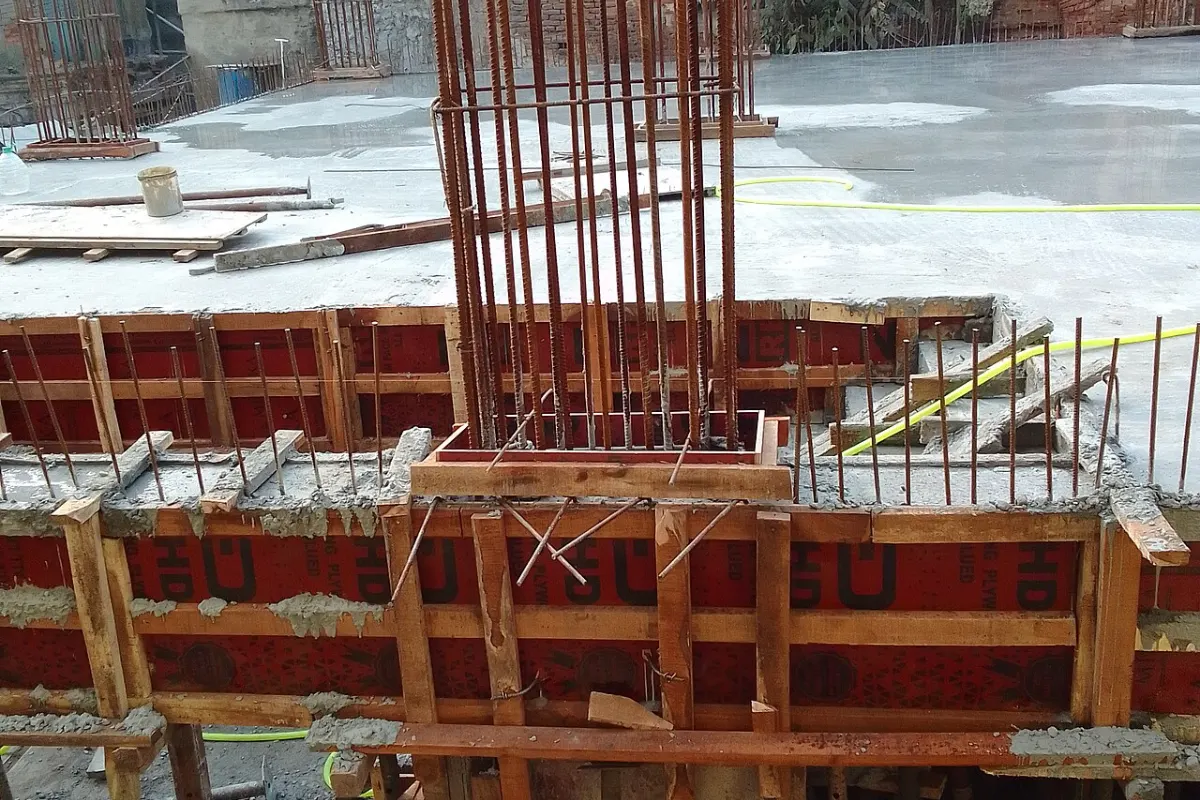
The heaviest loads a young slab carries often come during construction rather than in use: stacks of bricks and cement bags, bundles of steel, and in a building of several floors, the props and wet concrete of the floor above, which stand on a slab that may be only one or two weeks old. That is why props are often kept under two or three floors at once, as the engineer directs, until the lowest slab has the strength to carry what stands on it.
- Stack bricks and bags spread out and close to the beams and columns, never in a heap in the middle of a span or on a cantilever.
- Do not drop materials onto a new slab from a height.
- Build brick walls on a slab after its props have come out and it has taken its own weight, as the engineer directs. A wall built on a propped slab cracks when the props are removed and the slab settles.
- Keep props under cantilevers, such as balconies and sunshades, until the engineer says; they rely on the slab behind them and take longer to be safe.
- Fill a new water tank only when the slab under it has reached the strength the engineer set.

The cube results: 7 days and 28 days
Cubes are cast from the concrete at the pour and cured in water until they are crushed. IS 456 sets how many samples to take by the volume of concrete in the work: one sample for up to 5 m³, two for 6 to 15 m³, three for 16 to 30 m³, four for 31 to 50 m³, and one more for each further 50 m³. Each sample is three cubes, and our concrete grades guide explains how the results are accepted.
Seven-day results are an early warning. At that age a good mix usually reaches about two-thirds of its grade. A 7-day result well below that is a reason to keep the props in, find out why and test more, before anyone loads the slab. The 28-day results are the acceptance test.
Remember what the cubes measure. Standard cubes are cured in water in ideal conditions, so they show what the concrete could reach, not what your slab reached if it was left dry. Some sites cast a few extra cubes and keep them beside the slab, cured the same way, to judge when the props can safely come out.
When the clock says wait
The stripping times are minimums. In some situations the right answer is to wait longer, and a good engineer says so before the props are touched.
- Cold weather, or PPC or slag cement, which gain strength more slowly at first.
- Long spans, cantilevers and slabs that will soon carry heavy loads.
- Low 7-day cube results, or no cubes at all.
- A slab that was not cured properly, or that was rained on heavily in its first hours.
- Cracks, or sagging when the props are loosened.
- Remove slab props from the middle of the span working outwards to the supports, so the slab takes its weight gradually.
- Remove cantilever props from the free end back towards the support.
- Watch for cracks and sag as the props come out, and stop and re-prop if any appear.
The Kolkata seasons and the clock
Kolkata's weather moves the clock both ways. In April and May the heat speeds up early strength, but it also dries the surface within hours, so curing has to start early and the slab must not be left to bake on a hot afternoon. In December and January, cool nights slow the early gain, and engineers often keep the formwork in a little longer.
The monsoon keeps concrete wet, which helps curing, but heavy rain on a slab in its first hours washes out the cement paste and leaves a weak, dusty surface. Keep plastic sheets ready, plan pours around the forecast, and stop at a planned construction joint if a downpour arrives. Our guide to building through the monsoon and the Season Planner in our Lab cover the year's rhythm.
Using the Curing Clock
The Curing Clock is meant for owners and supervisors who want to understand where their slab is on the curve. Use it alongside your engineer's instructions and the cube results, never instead of them.
- Note the date and time of the pour, and the cement used.
- Slide the clock to the slab's age today to see its typical share of strength and the stage notes.
- Plan the props, the stacking of materials and the next pour from the stage notes.
- Check the plan against the 7-day cube results and the weather since the pour.
- Ask your engineer before removing props or loading the slab, especially in cold weather, with PPC, or under long spans.
Questions people ask
When can you walk on a new slab?
Lightly, to mark out the next columns, once it has hardened, usually after about a day. Keep it free of heavy loads, barrows and stacks for the first week, and keep it wet.
When can the props come out?
Under IS 456, for ordinary Portland cement concrete in normal weather, no sooner than 7 days under slabs spanning up to 4.5 m and 14 days over 4.5 m; beams take 14 to 21 days. Your engineer may set longer times for your slab.
When can brickwork start on a new slab?
After the props under it have come out and the slab has taken its own weight, as the engineer directs. Walls built on a propped slab tend to crack when the props are removed.
Is 7-day strength enough to load a slab?
No. At 7 days a slab usually has about two-thirds of its design strength. It is an early check that the concrete is on track, not a sign that the slab is ready for full loads.
Does PPC concrete take longer?
At first, yes. PPC gains strength more slowly in the first weeks, then keeps gaining for longer and often ends up stronger. Allow longer before stripping and loading, as your engineer directs.
Can late watering make up for missed curing?
Only partly. Concrete that dried out early loses some strength and durability near its surface for good. Curing works best from the first day, without gaps.
Try it in our Lab: Concrete Lab
Sources
- IS 456:2000 Plain and Reinforced Concrete, Code of Practice (clause 11.3 and Table 11, clause 13.5, clause 15) (Bureau of Indian Standards) (checked 15 Nov 2026)
- IS 516, methods of tests for strength of concrete (Bureau of Indian Standards) (checked 15 Nov 2026)
- IS 14687:1999 Falsework for Concrete Structures, Guidelines (Bureau of Indian Standards) (checked 15 Nov 2026)
Checked against these sources on the dates shown, pending our team’s sign-off.