External plaster & weather coat — the sequence that stops leaks
Walls leak at the details, not the flat areas: unfilled joints behind plaster, missing drip grooves under sills and chajjas, hairline plaster cracks facing the weather. External plaster wants two coats, curing like any concrete work, groove details at every projection, and a paint system rated for exteriors — in that order.
A raincoat with perfect fabric but no sealed seams still soaks you. Exterior walls fail at their seams — sills, junctions, parapet tops — while everyone stares at the fabric.
An outside wall in Kolkata faces months of humid air, weeks of driven rain and a summer sun that heats it and then lets it cool every night. Its plaster and paint are its raincoat. Most outside walls that leak do not leak through the middle of the plaster. They leak at the details: under sills and sunshades with no drip, at the top of parapets, around window frames, through cracks in plaster that was laid too thick in one go, and through joints in the brickwork that were never filled.
This guide explains what external plaster has to do, the wall behind it, the plaster itself and how it is laid, curing, the details that keep water out, the paint system on top, repairing a wall that already leaks, lime walls in older houses, and the checks. Our Plaster Material Calculator estimates the materials, our plaster checks guide covers plaster in general, and our paint defects guide explains what goes wrong with paint.
What external plaster has to do
- Shed rain without letting it soak through to the brickwork behind.
- Let the wall dry out when it does get wet, rather than trapping water inside it.
- Stay bonded to the wall through years of heat, cold, wetting and drying.
- Resist cracking from shrinkage and movement.
- Give a sound, even surface for the paint.
The wall behind it
Plaster cannot make up for a bad wall. Brickwork with hollow joints lets water run inside the wall behind the plaster; joints should be filled solid as the wall is built, as our brickwork guide explains. The wall should be clean, free of dust and loose mortar, with joints raked a little to give the plaster a key, and wetted before plastering so the bricks do not draw the water out of the plaster.
Where brickwork meets concrete columns and beams, a strip of galvanised mesh fixed across the joint before plastering stops the plaster cracking along it. Concrete surfaces need hacking or a bonding coat so the plaster grips them. Holes, chases for pipes and gaps around frames should be filled and allowed to set before the plaster goes over them.
The plaster and how it is laid
External plaster on brick is usually laid in two coats, totalling about 18 to 20 mm. The first coat, the backing coat, is laid and roughened to give the second a key, and left to set and cure. The second, the finishing coat, is thinner and gives the final surface. Two coats crack less than one thick coat, because each shrinks less and the cracks in the first are covered by the second. IS 1661, the Indian code for cement and cement-lime plaster, sets out how the coats are applied and cured.
The sand should be clean and graded for plaster, low in silt and clay, which cause cracking; our sand and silt guide and our M-sand guide explain the checks. Plaster should not be laid in hot midday sun on a west wall, in heavy rain, or on a wall that is soaking wet.
Curing
Plaster gains its strength and its resistance to water by curing, just as concrete does. Each coat should be kept damp for about seven days, as IS 1661 asks, by spraying it several times a day, starting as soon as it has set enough not to be damaged. On a sunny or windy face, covering it with hessian or sheeting helps. Plaster that dries out in a day or two cracks into a fine map pattern and stays weak and porous.
The details that keep water out
- A drip groove, a small channel, along the underside of every sill, sunshade, balcony and projection, so water drips off instead of running back under it to the wall.
- Sills sloped outward and projecting past the wall face.
- Window and door frames sealed to the wall with a flexible sealant, not just plastered up to.
- Parapet tops finished with a coping or a sloped waterproof cap, with a drip on the outer face, never left as raw brick-on-edge.
- Grooves cut at the junctions of different materials and at regular spacing on large walls, which control where shrinkage cracks form.
- Rainwater pipes fixed clear of the wall, and their joints sound.
- The plaster stopped short of the ground and the paving, above the damp-proof course, so it does not draw ground moisture up.
The paint system on top
- Let the plaster cure and dry before painting; paint makers commonly ask for about four weeks on new cement plaster.
- Repair any cracks first: hairline cracks with a crack-filling compound, wider ones after the engineer has said what they are.
- Apply an alkali-resistant exterior primer.
- Apply two coats of an exterior paint made for outside walls, with anti-algal protection for Kolkata's monsoon, at the maker's spreading rate.
- Paint in dry weather, not on a wet wall or in the midday sun.
Exterior paint is a thin film. It can shed rain and slow water down, but it cannot bridge cracks that were already in the plaster. A wall that leaks needs its cracks and details fixed, not a thicker coat of paint.
Repairing a wall that leaks
- Find where the water gets in: under a sill or sunshade, at a parapet, around a window, through cracks, through a leaking pipe, or through the wall itself; our damp guide helps.
- Fix the details first: cut drip grooves, seal frames, cap parapets, repair pipes.
- Tap the plaster over the area and cut out every hollow patch back to sound plaster.
- Rake out and fill the cracks; have wide or growing cracks checked by an engineer.
- Replaster the cut-out areas in coats, and cure them.
- Prime and repaint with an exterior system, and ask the painter to price the crack treatment as its own item.
Lime walls in older houses
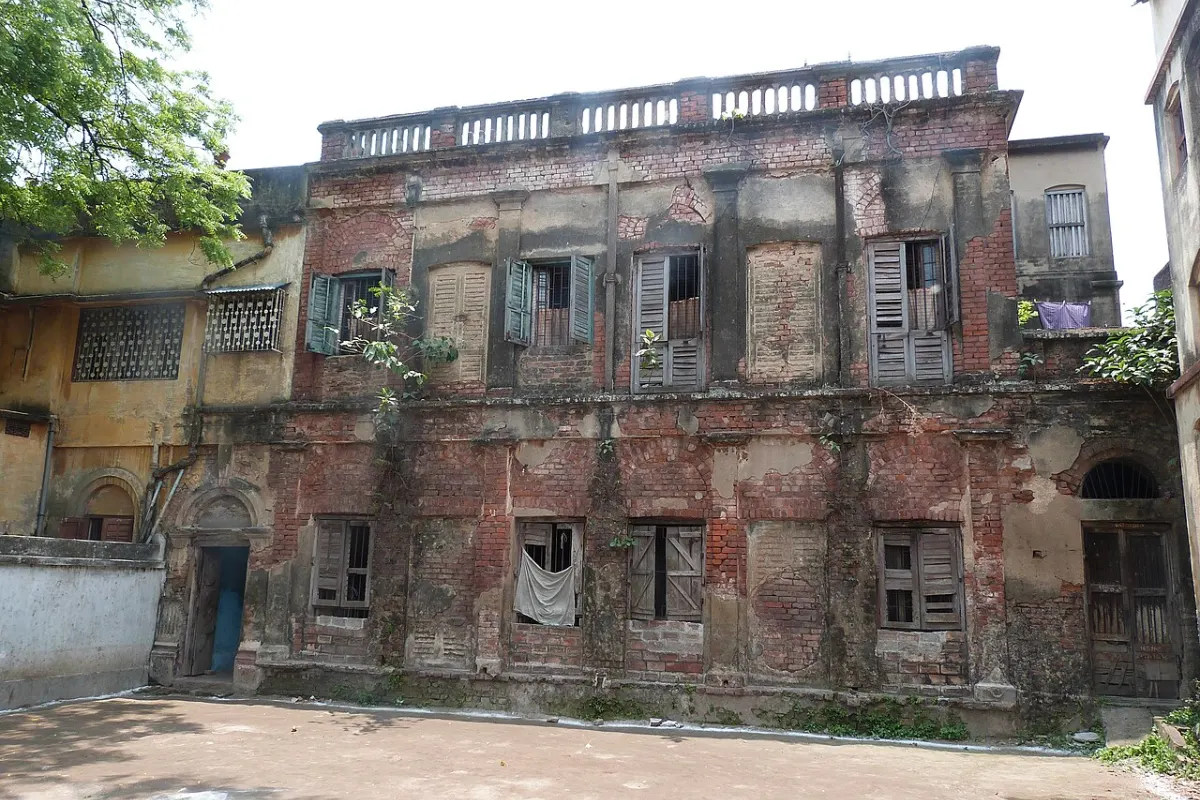
Many older Kolkata houses have thick brick walls in lime mortar with lime plaster. Lime lets a wall breathe: water that gets in can dry out again through it. Covering such a wall with dense cement plaster and a plastic paint can trap water inside, which then pushes the new plaster and paint off, and carries salts to the surface. Repairs to these walls are best done in lime plaster or a breathable plaster made for them, with a breathable paint. Our plaster guide explains the choice.

Checks
- Brickwork joints filled, the wall cleaned, wetted and meshed at concrete junctions before plastering.
- Two coats, each cured for about a week.
- Drip grooves under every projection, checked with a finger.
- Parapets capped and sloped, sills sloped and projecting.
- No hollow sound when the finished plaster is tapped.
- No map cracking before painting.
- Primer and two coats of exterior paint, from a named maker.
Details that decide dryness
- Drip groove (a small channel) on the underside of every sill, chajja and projection — without it, water curls along the soffit straight into the wall.
- Parapet tops finished with a coping or waterproof mortar cap sloped to the roof side, never left as raw brick-on-edge.
- External plaster in two coats totalling 18–20mm on brick, cured for 7 days minimum — single thick coats crack by shrinkage.
- Weather-coat paint applied on primer over dry plaster; exterior emulsion is a film membrane, and it can't bridge cracks that were already there.
For repainting-era buildings
If the facade shows map cracks, painting alone lasts one monsoon. The system is: rake and fill cracks (crack-fill paste for hairline, mortar for structural-width after assessment), one coat of exterior primer, then two coats of weather coat. Ask the painter to quote the crack-treatment step separately — that's where quotes silently differ.
Questions people ask
How thick should external plaster be?
On brick, usually two coats totalling about 18 to 20 mm. Two coats crack less than one thick coat.
How long should external plaster be cured?
Each coat for about seven days, as IS 1661 asks, kept damp several times a day.
What is a drip groove?
A small channel on the underside of a sill, sunshade or projection that makes rainwater drip off instead of running back to the wall.
Why does an outside wall leak after repainting?
Usually because the water gets in at a detail, such as a sill without a drip, a parapet top or a crack, and paint alone cannot stop it there.
How long should new plaster wait before painting?
Paint makers commonly ask for about four weeks on new cement plaster, then an alkali-resistant primer.
Can cement plaster be used on an old lime wall?
It is usually better not to. Dense cement plaster can trap water in a lime wall. Use lime or a breathable plaster made for such walls.
Red flags
- No drip grooves under any projection
- Parapet tops painted but never capped
- Single-coat 'thick' plaster done in a hurry before festival deadlines
Pro tip
Persistent damp on an upper-floor external wall after repainting means the water path is a detail, not the paint — worth a professional survey before the third repaint.
Work it out: Plaster Material Calculator
Sources
- IS 1661 Code of Practice for Application of Cement and Cement-Lime Plaster Finishes (Bureau of Indian Standards) (checked 15 Nov 2026)
- IS 2395 Painting Concrete, Masonry and Plaster Surfaces, Code of Practice (Bureau of Indian Standards) (checked 15 Nov 2026)
- CPWD Specifications (plastering and painting) (checked 15 Nov 2026)
Checked against these sources on the dates shown, pending our team’s sign-off.