Fire safety retrofits for older buildings
Older buildings usually fail on four fronts: aged wiring (the #1 ignition source), no early warning (no smoke detectors), blocked or single escape routes, and zero first-response equipment. The good news: standalone smoke alarms, extinguishers on each floor, a cleared staircase and an electrical audit are all retrofittable in days, not months — no structural work needed for the basics.
Fire safety layers are like vehicle safety: the audit is maintenance, alarms are the warning lights, extinguishers are the airbag, and the clear staircase is the seatbelt. No single layer is enough; together they change outcomes completely.
Most fires in homes and older buildings start small: an overheated socket, a forgotten pan, a spark in a meter room crowded with old cables. What turns a small fire into a deadly one is usually the building around it: no early warning, smoke filling the only staircase, an exit locked for the night and nothing at hand to put out the first flames. Many older buildings in Kolkata, put up before today's fire rules, have all four weaknesses.
This guide explains how fires start and spread in older buildings, the retrofit ladder from the cheapest measures up, what to do about wiring, alarms, extinguishers and escape routes, what larger and taller buildings need under the state's fire rules and the national standard that replaced the National Building Code in 2026, what is particular to Kolkata, how a household plans for a fire, and a checklist for a building's yearly walk-round. Most of the basics need no structural work and can be done in days.
How fires start and spread in older buildings
Electrical faults are one of the commonest causes of fires in homes and offices. Old wiring with perished insulation, loose joints, rewireable fuses and circuits carrying far more than they were laid for, with air conditioners, geysers, induction hobs and inverter batteries added over the years, heat up slowly until something catches. Kitchens add gas and hot oil; stairwells, meter rooms and lofts add stored paper, furniture, goods and old mattresses that burn readily.
Smoke, not flame, causes most deaths in building fires. It rises fast, and an open staircase acts as a chimney, carrying hot smoke to the upper floors within minutes and blocking the only way down. That is why early warning, closed doors and a clear way out matter as much as putting the fire out.
- Ignition: old or overloaded wiring, kitchens, stored materials near heat.
- Warning: no smoke alarms, so a fire at night is found late.
- Escape: one staircase, often cluttered, with gates or terrace doors locked.
- First response: no extinguisher, no blanket, no plan.
The retrofit ladder, cheapest first
Fire safety improves in layers, and the cheapest layers come first. Each one deals with a different weakness, and together they change what happens in a fire far more than any single measure.
- An electrical audit and repair of overloaded or aged circuits: it removes the commonest cause.
- Smoke alarms in sleeping areas and hallways, and a heat alarm in the kitchen: they buy time.
- An extinguisher on each floor and a fire blanket in the kitchen, with everyone shown how to use them.
- Clear escape routes: staircases, landings, the terrace and the meter room free of storage, and every gate and door openable from inside without hunting for a key.
- A plan for the household and the building: two ways out, a meeting point, the numbers to call, a practice once a year.
- For larger and taller buildings: the fixed systems the rules ask for, such as alarms, hose reels, risers and fire doors, upgraded on a fire safety audit.
None of the first five steps needs structural work. Most can be done in a week, and they deal with the causes of most deaths in home fires.
Wiring: the cause to fix first
An electrical audit by a licensed electrical contractor is the first step in any fire safety retrofit; our rewiring guide explains what it involves. The audit looks at the distribution board, the cables, the earthing and the protective devices, and finds the circuits that are overloaded or failing. The electricity safety regulations require residual current protection, and a 30 mA residual current device on socket circuits and wet areas is good practice; miniature circuit breakers sized to each circuit's cable replace old rewireable fuses. Air conditioners and geysers get their own circuits, and new cables are copper, of the right size, with flame-retardant, low-smoke insulation.
In apartment blocks, the meter room deserves special care. It holds the supply cables and meters of the whole building in a small space, often with old wooden boards, dust and stored junk. Keep it clean and dry, closed with a fire-resistant door and never used for storage, and seal the openings where cables pass from floor to floor, so that a fire in a shaft cannot climb the building. Inverter batteries belong in a ventilated place, not in a bedroom or under the stair.
- Switches, sockets or plugs that feel warm.
- A burning smell, or scorch marks round a socket.
- Breakers or fuses that trip often, or lights that dim when an appliance starts.
- Rewireable porcelain fuses still in use.
- Cables with brittle, cracked or cloth-covered insulation.
- Extension boards plugged into other extension boards.
Early warning: smoke and heat alarms
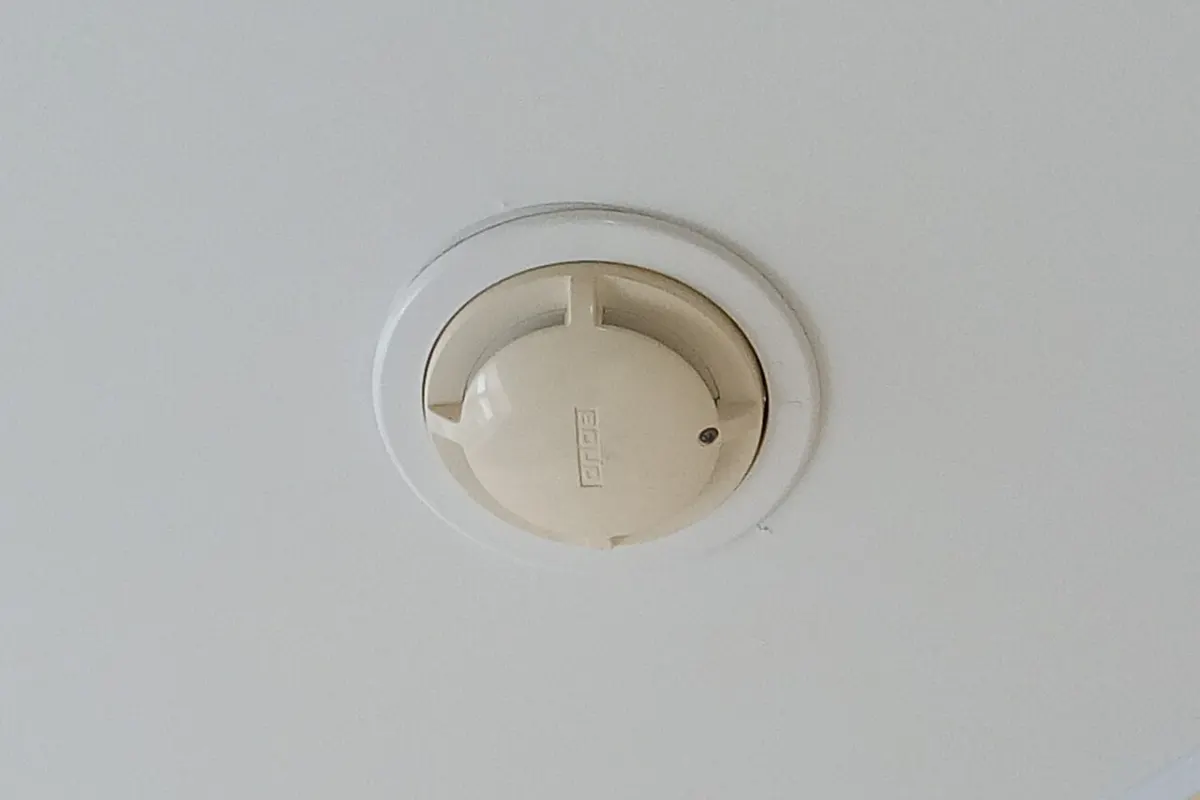
A smoke alarm is the cheapest life-saving device in a home. A standalone battery alarm screws to the ceiling in minutes and wakes the household while there is still time to get out. Optical (photoelectric) alarms respond well to slow, smouldering fires, such as a cigarette in a sofa or a smouldering cable; in the kitchen, where cooking sets smoke alarms off, a heat alarm is the better choice. In a house of several floors, alarms that are linked, so that one sets them all off, give the most warning.
Fit them on the ceiling, away from corners, fans, air-conditioner outlets and bathroom doors whose steam causes false alarms. Test each one every month with its button, change the batteries as the maker says, and replace the whole alarm at the end of its rated life, often about ten years. In larger buildings, the common areas need a proper alarm system with call points on each floor, as the fire rules require.
- One in each bedroom, or in the hallway outside the bedrooms.
- One in the living room and on each landing of a house.
- A heat alarm in the kitchen, not a smoke alarm.
- One in the meter room or near the distribution board, where it can be heard.

First response: extinguishers and fire blankets
A small fire can often be put out in its first minute or two. After that, the right thing is to get out. An ABC dry powder extinguisher suits most fires in a home, including electrical ones; a carbon dioxide extinguisher suits electrical panels and meter rooms, because it leaves no residue; a fire blanket smothers a pan fire. Never throw water on burning oil, and never on electrical equipment that is still live.
Buy extinguishers that carry the ISI mark (IS 15683), mount them on a wall near an exit at a height everyone can reach, not inside a cupboard, and have them serviced every year and after any use, as IS 2190 recommends. The pressure gauge should read in the green, and the service date should be on the tag.
- Pull the pin.
- Aim at the base of the fire, not the flames.
- Squeeze the handle.
- Sweep from side to side until the fire is out, keeping a clear way out behind you.
Fight a fire only if it is small, you have a clear way out behind you and someone has called the fire service on 101 or the emergency number 112. Otherwise get everyone out and close the doors behind you: a closed door holds smoke back.
Escape routes: the staircase is the lifeline
Most older buildings have one staircase. It is the only way out for everyone above the ground floor, so anything that blocks it, or fills it with smoke, can trap them. Keep stairs and landings clear of shoe racks, cupboards, bicycles, scooters, gas cylinders and furniture. Do not charge electric scooters or bicycles on the stair or in the lobby: lithium batteries can catch fire while charging and fill a staircase with toxic smoke.
Collapsible gates at the foot of the stair and terrace doors locked at night are common in Kolkata buildings for security. A gate locked between the residents and the street, or the terrace, becomes a trap in a fire. Fit locks that open from the inside without a key, or keep keys in a break-glass box beside each gate and with every flat. Keep the terrace door openable and the terrace clear, because it is the refuge when the stair below is full of smoke.
- Nothing stored on the stair, the landings, the terrace or in the meter room.
- Every gate and door on the way out openable from inside, quickly, in the dark.
- Self-closing doors to the stair where the layout allows, so smoke stays out of it.
- Emergency lights and glow-in-the-dark signs on the stair.
- Where there is only one stair, a second way out considered in any renovation: an outside stair, or access to a neighbouring terrace, designed by an engineer.
Larger and taller buildings
The rules ask more of larger buildings. West Bengal Fire and Emergency Services treats a building above 14.5 m as high-rise, and a residential building above that height needs a fire safety recommendation before its plan is sanctioned, with a fire safety certificate at completion. The state also lists a housing complex of more than eight dwelling units as a high-risk building. Nationally, the National Building Code of India 2016, Part 4 Fire and Life Safety, set what each type and height of building needed. BIS replaced it on 30 April 2026 with the National Building Construction Standards 2026, whose Part F Fire and Life Safety is guidance for the states and counts a building as high-rise from 24 m (the 2016 code: 15 m). It sets out staircases of set widths, fire doors, hose reels, wet risers or downcomers, sprinklers in the tallest buildings, alarm systems, emergency lighting and signs, and water kept aside for firefighting. In Kolkata the state's 14.5 m line is the one a plan is checked against.
Many older blocks were built before these rules and have few of them. An upgrade starts with a fire safety audit by a qualified engineer against the current rules; some measures need the fire service's approval, and many can be done floor by floor while residents stay in.
- Fire-stopping in cable and plumbing shafts at every floor.
- Fire-resistant, self-closing doors to the meter room, the lift lobby and the stair.
- A manual fire alarm with a call point and a sounder on each floor.
- Hose reels or a downcomer on the stair, and the firefighting water reserve kept full.
- Emergency lighting and exit signs on every landing.
- Clear access for a fire engine, kept free of parked cars.
What is particular to Kolkata
Older parts of Central and North Kolkata mix shops and godowns on the ground floor with homes above, sharing one stair, with goods stored on landings and wiring run through timber floors. Many lanes are too narrow for a fire engine to reach the door, so early warning, a clear stair and a first response at home matter even more. The city's own fires, such as Stephen Court on Park Street in 2010 and the AMRI hospital in Dhakuria in 2011, showed how locked exits, stored materials and old wiring can turn a fire into a disaster, and led to stricter inspections.
The seasons add their own risks. Summer pushes air-conditioner loads onto old circuits; the monsoon brings water into meter rooms, junction boxes and basements; and the festival months bring decorative lighting on temporary wiring, diyas and candles near curtains, and firecrackers on terraces and balconies.
A fire plan for the household
- Know two ways out of each room where possible, and of the building.
- Agree a meeting point outside, away from the building.
- Keep 101 for the fire service and 112 for emergencies by the door and in every phone.
- Keep keys to gates and the terrace where everyone can find them in the dark.
- Show everyone how to use the extinguisher, shut the gas at the cylinder and switch off the main supply.
- In smoke, stay low, close doors behind you and never use the lift.
- If you cannot get out, close the door, block the gap with wet cloth, go to a window and call for help.
- Practise once a year, with children and older family members.
The yearly walk-round
Once a year, before the summer and the festival months, walk the building with this list. In an apartment block it is a job for the association, with one person responsible for each item.
- Staircases, landings, the terrace and the meter room clear.
- Gates and terrace doors openable from inside, keys in place.
- Smoke alarms tested and batteries changed where needed.
- Extinguishers serviced, gauges in the green, the service date on the tag.
- The meter room's door closing, its cables tidy, no water getting in.
- Emergency lights and signs working.
- Shaft openings sealed at each floor.
- Access for a fire engine clear.
The retrofit ladder — cheapest first
- Electrical audit and rewiring of overloaded or aged circuits — attacks the cause.
- Battery smoke alarms in kitchens, meter rooms and sleeping areas — attacks response time.
- ABC extinguishers on every floor, with a two-minute walkthrough for the household.
- De-clutter and, where possible, add a second escape path (roof access counts).
- For larger or commercial buildings: hydrant and alarm systems per fire-license requirements.
Questions people ask
Does an old house need rewiring to be safe from fire?
Not always, but it needs an electrical audit. Many fires in older buildings start in old or overloaded wiring, and the audit shows whether a repair, a new distribution board or a full rewire is needed. Our rewiring guide lists the signs.
Where should smoke alarms go in a flat?
On the ceiling of each bedroom, or the hallway outside them, and in the living room, away from the kitchen's steam, bathroom doors, fans and air-conditioner outlets. Use a heat alarm in the kitchen, and test every alarm each month.
Which extinguisher suits a home?
An ISI-marked ABC dry powder extinguisher covers most home fires, including electrical ones, and a fire blanket suits a pan fire. Keep them near an exit, have them serviced every year, and never use water on burning oil or live electrics.
Is a locked gate on the staircase safe?
A gate locked with no key at hand can trap residents in a fire. Fit a lock that opens from the inside without a key, or keep keys in a break-glass box beside the gate and with every flat.
Does an older apartment block need fire approval?
The fire safety recommendation and certificate apply when buildings above 14.5 m, and other high-risk buildings, are planned and completed. An older block can still be audited against today's rules and upgraded step by step; West Bengal Fire and Emergency Services can say what applies to yours.
Can electric scooters be charged in the stairwell?
Not safely. Lithium batteries can catch fire while charging and fill a staircase with toxic smoke, blocking the only way out. Charge them in a ventilated space away from the escape route, with the maker's own charger.
Red flags
- Meter room or staircase used as storage — fuel on the escape route
- A single stair with a grille gate that's kept locked
- Extension boards daisy-chained off one aging socket
Pro tip
Fire safety upgrades are one of our retrofitting sub-services — typically the fastest, highest-return work order in the whole catalogue.
Sources
- National Building Code of India 2016, Part 4 Fire and Life Safety (Bureau of Indian Standards) (withdrawn by BIS on 30 April 2026; replaced by the National Building Construction Standards 2026, SP 7:2026) (checked 15 Nov 2026)
- WBFES: fire safety recommendation (checked 14 Oct 2026)
- IS 2190 selection, installation and maintenance of first-aid fire extinguishers, and IS 15683 portable fire extinguishers (Bureau of Indian Standards) (checked 15 Nov 2026)
- Central Electricity Authority (Measures relating to Safety and Electric Supply) Regulations, 2023 (checked 15 Nov 2026)
- National Disaster Management Authority: fire safety, do's and don'ts (checked 15 Nov 2026)
- National Building Construction Standards 2026 (SP 7:2026), Part F Fire and Life Safety (Bureau of Indian Standards) (checked 28 Nov 2026)
Checked against these sources on the dates shown, pending our team’s sign-off.