Honeycombing — the concrete void that hides in your columns
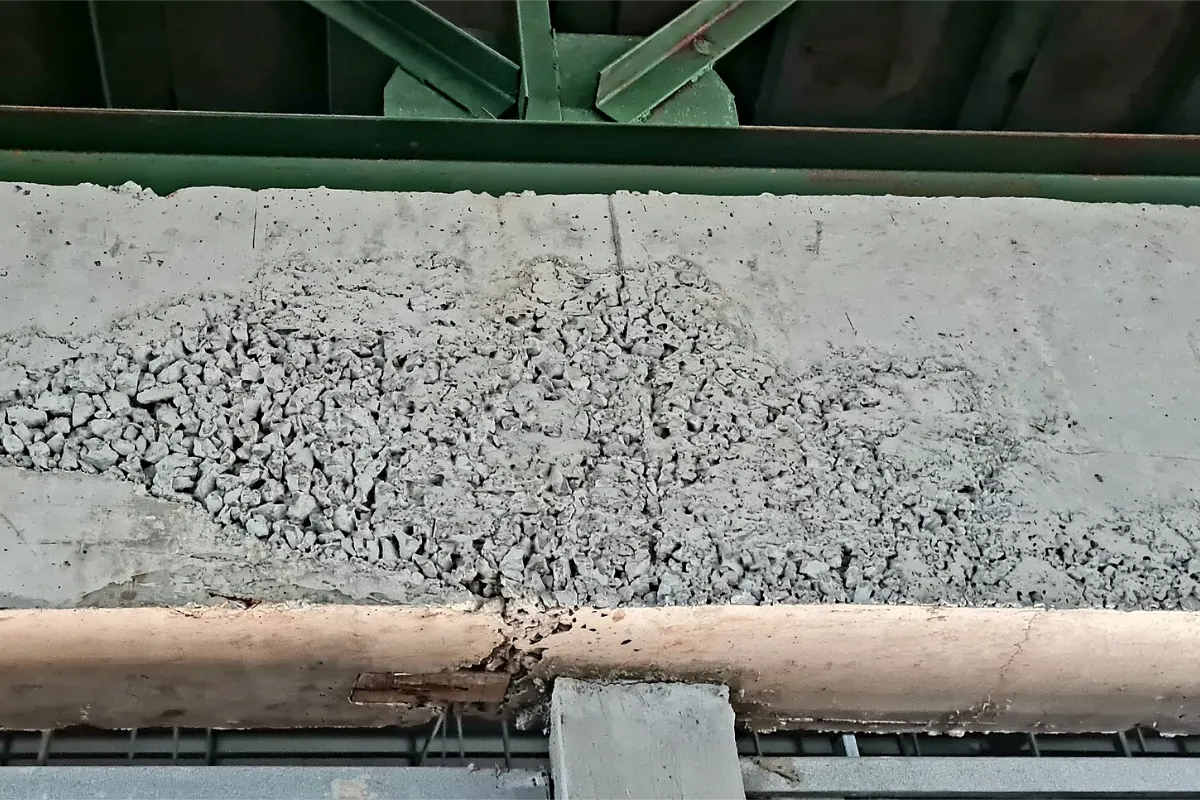
Honeycombing is the rough, pitted, stony patch you see on stripped concrete where the cement paste failed to fill the gaps between the stones, leaving voids. It usually means the concrete wasn't vibrated (compacted) properly during the pour, or the mix was too stiff, or the steel was too congested. Small surface honeycombing is repairable; deep voids around the reinforcement are a durability problem, because they let water reach the steel.
Good concrete should be like a dense fruitcake — stones evenly held in a solid batter. Honeycombing is a cake where the batter didn't reach everywhere, leaving hollow pockets. The gaps are exactly where damp and rust get in.
When the shuttering comes off a column or a beam, the concrete should be dense and even, showing the faint pattern of the boards it was cast against. Sometimes it shows rough, stony patches instead, with holes between the stones where the cement paste never reached. That is honeycombing, one of the commonest defects on Indian building sites. Some of it is only skin-deep. Some reaches the steel and weakens the member. The difference matters, and it can only be judged before the plaster goes on.
This guide explains what honeycombing is and why it happens, how to tell shallow from serious, how an engineer assesses it, how it is repaired properly and why plaster is not a repair, how to prevent it, and what to watch during and after a pour. Our Concrete Lab shows how concrete is chosen, mixed and cured, and our shuttering guide covers the formwork.
What honeycombing is
Fresh concrete is a mix of stone, sand, cement and water, full of trapped air when it is placed. Compacting it, normally with a poker vibrator, drives the air out and lets the mortar flow around every stone and every bar. Where that does not happen, the stones sit touching each other with empty gaps between them: honeycombing. It can show at the surface or hide inside a member.
It is different from blowholes, the small round air bubbles often seen on smooth concrete faces, which are mostly cosmetic. Voids weaken concrete out of proportion to their size; even a few per cent of trapped air costs a noticeable part of the strength. Worse, they open a path for water and air to reach the steel, which then rusts. IS 456 requires concrete to be thoroughly compacted during placing, and treats this as part of good workmanship, not an optional extra.
Why it happens
- No vibrator on site, a vibrator that broke down mid-pour with no spare, or one used too briefly or at points too far apart.
- Concrete too stiff to flow, because it was mixed too dry, waited too long before placing, or was poured in hot weather without the right admixture.
- Water added on site to make concrete flow, then not compacted properly, which also weakens it.
- Concrete dropped from a height into a tall column form, so that the stones separate from the mortar and pile up at the bottom.
- Steel bars packed so closely that the stones cannot pass between them. IS 456 asks for the gap between bars to be at least the largest stone size plus 5 mm.
- Shuttering with gaps at the joints or at the foot of a column, so that the cement slurry leaks out and leaves stones behind.
- Missing cover blocks, so the bars sit against the shuttering and the concrete cannot get round them.
- Layers placed too deep for the vibrator to reach through.
Shallow or serious
| What you see | What it usually means | What it needs |
|---|---|---|
| Small round holes on a smooth face | Blowholes: trapped air at the surface | Usually a fine filler before finishing |
| Rough, stony patch, stones firmly held, no steel visible | Shallow honeycombing within the cover | A proper patch repair after cleaning back |
| Deep voids with loose stones, steel visible | Deep honeycombing reaching the steel | An engineer's assessment and a structural repair |
| Hollow sound when tapped, though the face looks fine | Voids inside the member | Testing to find the extent, then repair |
| Honeycombing at the foot of a column, at a beam-column joint or under a beam | Defects where the forces are highest | Always an engineer's assessment, whatever the size |
How an engineer assesses it
- A careful look and a hammer tap over the whole member, mapping where it sounds hollow.
- Chipping into the patch to find how deep the voids go and where sound concrete begins.
- Checking the steel: whether it is exposed, displaced or already rusting.
- Non-destructive tests covered by IS 516, such as the rebound hammer and ultrasonic pulse velocity, to look for hidden voids.
- Cores cut from the member where the strength itself is in doubt.
- The site records: the test cube results for that pour, and how it was placed and compacted.
- How important the member is: a column carrying several floors is judged more strictly than a parapet.
Repairing it properly
- Prop the member first if the engineer finds the damage serious enough to affect its strength.
- Cut out all loose and weak concrete back to sound, dense concrete, with square edges rather than thin feathered edges that break away.
- Clean the steel of rust and loose scale; replace or add steel where the engineer finds it necessary.
- Wash out the dust and wet the surface, leaving it damp but with no standing water.
- Apply a bonding coat where the repair material calls for one.
- Fill shallow patches with a polymer-modified repair mortar in layers; fill deep voids with a free-flowing micro-concrete placed in a shutter; fill hidden internal voids by pressure grouting through drilled ports.
- Cure the repair as carefully as new concrete.
- Check the result by tapping and, for important members, by testing again.
Plaster is not a repair. A coat of cement plaster or putty over honeycombing hides the voids but leaves them open to water. The steel behind starts to rust out of sight, and the problem comes back years later as cracks and falling concrete. The CPWD handbook on repairs sets out the proper methods.
Preventing it
- A mix designed to flow enough for the member, with any extra workability coming from an admixture, not from water added on site.
- At least one working poker vibrator for each placing point, and a spare on site.
- The vibrator inserted vertically at close, regular spacing, held until air bubbles stop rising, and withdrawn slowly; it compacts concrete and should not be used to push it along.
- Concrete placed in layers no deeper than the vibrator can reach, each worked into the one below.
- Tall columns filled through a pipe or a window in the form, not dropped from the top.
- Shutter joints tight and sealed, especially at the foot of each column.
- Cover blocks in place, and the bar spacing checked before the pour.
- Ready-mixed concrete placed within the time its supplier allows.
During the pour: what to watch
- Is the vibrator running at every column and beam, and is there a spare?
- Is slurry leaking from shutter joints or the foot of a column?
- Is water being added to concrete because it has stiffened?
- Is concrete being tipped into a tall column from the top in one go?
- Is the vibrator being used to spread concrete instead of compacting it in place?
- Is the pour running into the evening with fewer hands than it started with?
After the shutters come off
Inspect every column and beam as soon as its shuttering is removed, before anyone touches it with plaster, putty or a cement wash. Photograph any honeycombing with a scale, note the member, and ask for the engineer's decision before repair. A patch quietly filled before you could see it is a warning sign, because a shallow defect and a deep one look the same once covered. Your contract should say that defective work is made good at the contractor's cost and in the way the engineer directs.

What we see in Kolkata
On small house sites, concrete is still sometimes mixed and placed with too few hands and no vibrator, or poured during monsoon showers and humid evenings that hurry the work. Columns in taller buildings are often packed with steel, which makes compaction harder. Our retrofitting team sees the result decades later: spalling and rusted bars in columns and beams that turn out to have been honeycombed from the day they were cast. The fix then is far larger than it would have been if the defect had been caught when the shutters came off.
Why it happens
- No or poor vibration during the pour — the single biggest cause.
- Concrete too dry or stiff (often because water was withheld, or it was poured too long after mixing).
- Reinforcement bars packed too close for the stones to pass between them.
- Shuttering with gaps that let the cement slurry leak out.
When to worry
Isolated shallow pitting on a non-critical surface can be patched with a repair mortar. But honeycombing that's deep, that exposes the steel, or that appears on columns and beams (the critical load-carriers) needs an engineer's assessment and a proper structural repair — never just a skim of plaster to hide it.
Questions people ask
Is some honeycombing normal on a building site?
Small blowholes on smooth faces are common and mostly cosmetic. Rough, stony patches with voids are a defect in compaction, and deep ones are not acceptable. Every case should be seen before plaster goes on.
Can honeycombing be plastered over?
No. Plaster hides the voids but does not fill or seal them. Water still reaches the steel, which rusts and cracks the concrete later. Honeycombing has to be cut back and repaired with the right material.
Does honeycombing weaken a column?
Shallow honeycombing within the cover mainly affects durability. Deep honeycombing that reaches the steel, or is at the foot of the column or at a joint with a beam, can reduce its strength and needs an engineer's assessment.
Who pays to repair honeycombing?
It is a workmanship defect, so normally the contractor, at their cost and as the engineer directs. Your contract should say so.
How soon should honeycombing be repaired?
As soon as the engineer has assessed it, and always before plaster or finishes cover it. Leaving it open in the monsoon lets the steel start to rust.
Can honeycombing be found in an old building?
Yes. An engineer can locate it by tapping and with non-destructive tests, and it often shows itself as cracking or spalling over rusted bars.
Red flags
- Rough, stony voids visible when shuttering is removed
- Steel bars visible inside a honeycombed patch
- Honeycombing quietly plastered over before you can see it
Pro tip
Inspect columns and beams the moment shuttering comes off, before any plaster hides them. If you see voids near the steel, stop and get it assessed — this is exactly the hidden defect our retrofitting team is called in to fix years too late.
Try it in our Lab: Concrete Lab
Sources
- IS 456:2000 Plain and Reinforced Concrete, Code of Practice (checked 15 Nov 2026)
- IS 516 Methods of Tests for Strength of Concrete, including non-destructive testing (Bureau of Indian Standards) (checked 15 Nov 2026)
- IS 3558 Code of Practice for Use of Immersion Vibrators for Consolidating Concrete (Bureau of Indian Standards) (checked 15 Nov 2026)
- CPWD Handbook on Repair and Rehabilitation of RCC Buildings (checked 15 Nov 2026)
Checked against these sources on the dates shown, pending our team’s sign-off.