Rainwater harvesting & site drainage — designing for Kolkata rain
Kolkata gets ~1,600mm of rain a year, most of it in four months. A plot that isn't graded to drain, with no rainwater pits and undersized roof outlets, ponds water against the plinth — the slow killer of foundations and ground-floor walls. Drainage is designed before construction, not improvised after the first flood.
Think of your plot as a shallow bowl. If the building sits at the lowest point, every monsoon pours into it. Grading and drains tilt the bowl so water leaves on its own.
Kolkata gets well over 1,500 mm of rain in a normal year, most of it between June and September, and much of that in short, heavy bursts. A plot that is not designed for it ponds water against the walls, floods the ground floor when the street drain backs up, soaks the foundations season after season, and loses to the drain every drop it could have kept. Good site drainage and rainwater harvesting are designed together, before construction, and cost little when they are.
This guide explains what the monsoon does to a plot, setting the plinth and the levels, roof drainage, surface drainage and the connection to the street drain, rainwater harvesting and recharge, what the building rules ask, the details that fail, and the checks before each monsoon. Our Rainwater Harvesting tool in the Lab and the Rainwater Harvesting calculator size a sump and recharge pit for your roof, and our plinth and DPC guide covers the ground floor.
What the monsoon does to a plot
- Water stands against the plinth and soaks into the foundations and the bottom of the walls, feeding rising damp and salts.
- Low ground floors take water from the street when the drains back up in a cloudburst.
- Roof outlets that block send water over parapets and down the outside walls.
- Soil under paving and around the foundations is washed out where water runs without a channel.
- Water left standing breeds mosquitoes within a week.
- Every litre that runs to the drain is a litre lost to the sump and the ground below.
The plinth and the levels
Drainage starts with levels. The ground floor should sit well above the road and the highest water ever seen in the lane, with a margin for the road being raised again; our plinth and DPC guide explains why so many older Kolkata houses now sit below their roads. Around the building, the ground and paving should fall away from the walls, so water moves out, not in.
A level survey of the plot, the road and the street drain, done before the design, shows where water will go and where the outfall can be. Ask the neighbours how high the water came in past monsoons; it is often the most useful number you will get.
Roof drainage
Flat roofs should be laid to falls towards their outlets, so no water stands, and the outlets should be sized for the heaviest bursts of rain, not the average. The National Building Construction Standards 2026 (Part E, Table 25) size rainwater pipes from the rainfall intensity: a 100 mm pipe drains about 84 square metres of flat roof in rain of 100 mm an hour, and 56 in rain of 150 mm an hour. Many builders still allow one 100 mm pipe for every 40 square metres or so, which leaves room for the city's heaviest bursts. Our Rainwater Harvesting tool uses the standard's figure for rain of 100 mm an hour.
- At least two outlets for any roof, so one blockage does not flood it.
- An overflow spout through the parapet, set a little above the roof, so a blocked outlet shows itself instead of leaking.
- Outlets with grating or domes to keep leaves and plastic out.
- Rainwater pipes fixed firmly, with bends that can be cleaned, and kept out of walls where a leak would be hidden.
- Pipes discharging into a drain, a harvesting system or a splash block, never onto the foot of the wall.
Surface drainage and the street drain
Paving around the building should fall away from it, at about 1 in 100 at the least, to a drain along the edge of the plot. The drain leads to the municipal drain through a silt trap or a chamber that catches sand and rubbish before it enters, and is easy to clean. Where the street drain is higher than your plot in heavy rain, a non-return flap on the outfall stops water coming back in, and a sump with a pump may be needed for the lowest areas.
Keep surface water and sewage apart. Rainwater pipes and yard drains should not run into the soil and waste system, and sewage should never run into a rainwater or recharge system.
Harvesting and recharge
Rainwater from the roof is the cleanest water a plot receives, and it can be kept in two ways. Storage collects it in a sump or tank for flushing, washing, gardening and, with treatment, more. Recharge leads it into the ground through a recharge pit or well, where it tops up the groundwater that borewells draw on. Many plots do both: the sump fills first, and the overflow goes to recharge.
- Use roof water only. Water from paving, roads and drains carries oil, waste and germs.
- Fit a first-flush device that sends the first few minutes of each rain, with the roof's dust, to the drain.
- Filter the water before storage or recharge, through a filter chamber or a filter unit.
- Keep recharge pits at least a couple of metres from the building's foundations, and well away from septic tanks and soak pits.
- In Kolkata's clay, a shallow pit soaks away slowly; a recharge well or shaft that reaches a sand layer works better.
- Cover and seal storage sumps, and fit the overflow and vents with mesh against mosquitoes.
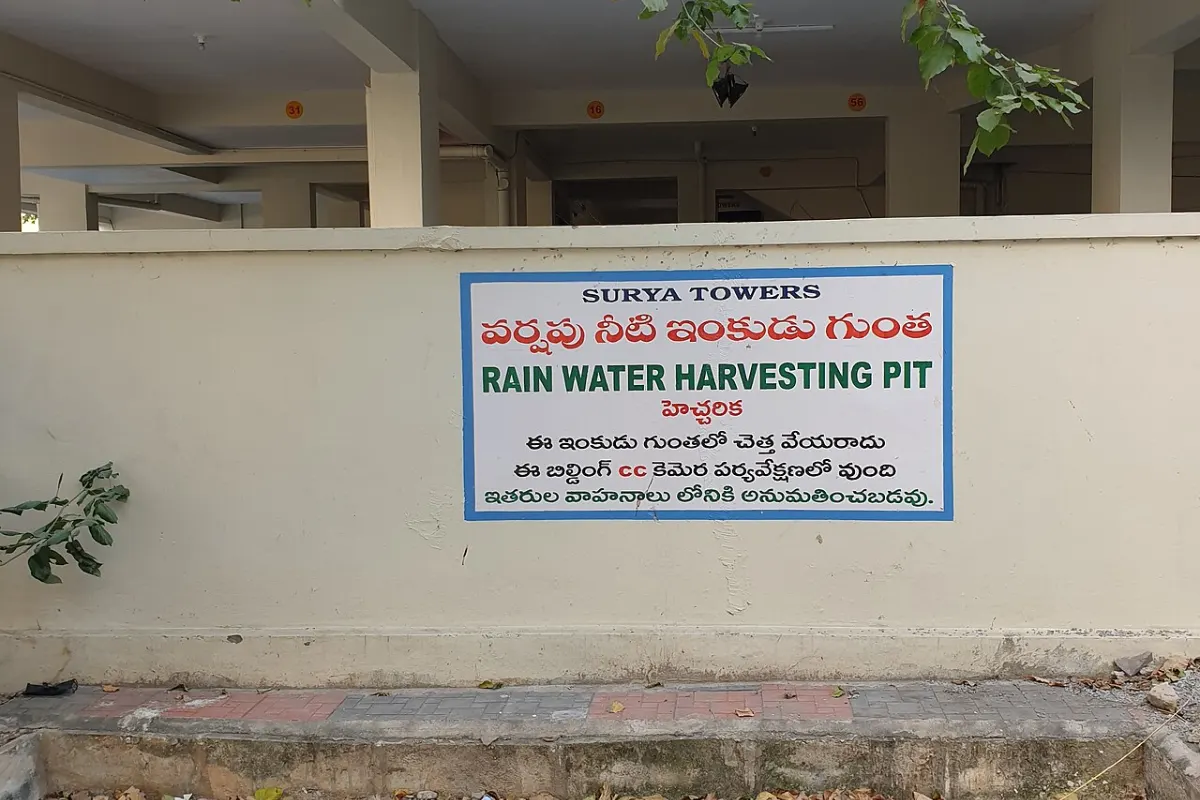

What the rules ask
The KMC Building Rules, 2009, ask for rainwater harvesting arrangements in new buildings above set sizes, and the amendments notified in September 2025 (a draft in April 2025) tighten the requirements for large buildings; check the rule that applies to your plot when the plan is prepared. The municipalities have their own rules. The Central Ground Water Board publishes guidance on recharge structures. Our sanction plan guide explains what goes on the plan.
Details that fail
- A single roof outlet, with no overflow, blocked by leaves in the first storm.
- Paving laid flat or sloping towards the building.
- A yard drain with no silt trap, which chokes in the first season.
- Rainwater pipes buried in walls, leaking unseen for years.
- Recharge pits fed from the yard and the road, which pollute the groundwater.
- Harvesting sumps left open, breeding mosquitoes.
- The street drain higher than the plot, with no flap and no plan for the heaviest rain.
Before each monsoon
- Clear the roof, the outlets, the gratings and the overflow spouts.
- Run water down every rainwater pipe and check the joints and fixings.
- Clean the yard drains, the silt traps and the chamber at the outfall.
- Clean the first-flush device and the filter, and replace the filter media if it is clogged.
- Check the recharge pit or well is soaking away, and clean its top layer if needed.
- Check the sump's cover, vents and overflow mesh.
- Look along the foot of the walls for standing water after the first rain, and fix the slopes.
What a proper rain plan includes
- Plinth level set above the road and the highest recorded waterlogging line for the street — ask neighbours, not just the surveyor.
- Roof outlets sized and doubled: one blocked drain on a flat roof in a cloudburst means water finds the parapet joints instead.
- A rainwater harvesting pit or recharge well — mandatory for many plot sizes under KMC norms, and it drops your borewell's TDS over time.
- Surface grading of paving at 1:100 minimum away from the building, with a peripheral drain tied to the municipal line through a silt trap.
For engineers & contractors
Check the roof drainage calculation: one 100mm rainwater pipe drains roughly 40–50 sqm of flat roof in Indian intensity conditions. Count the outlets on the terrace plan and do the division — undersizing shows up in the first big shower, as sheet overflow at the parapet.
Questions people ask
Is rainwater harvesting compulsory in Kolkata?
The KMC Building Rules ask for it in new buildings above set sizes, and the amendments of September 2025 tighten this for large buildings. Check the rule for your plot when the plan is prepared; the municipalities have their own rules.
How many roof outlets does a terrace need?
Enough for its area and the heaviest rain, and never fewer than two. By the 2026 standards a 100 mm pipe drains about 84 square metres of flat roof in rain of 100 mm an hour; many builders allow one for every 40 square metres or so.
Can rainwater be used for drinking?
Only after proper filtration and disinfection, and a test against the drinking water standard. Most homes use stored rainwater for flushing, washing and gardening.
Does a recharge pit work in clay soil?
A shallow pit in clay soaks away slowly. A recharge well or shaft that reaches a sand layer works much better.
Why does the ground floor flood when it rains heavily?
Usually because the plinth is below the road or the street drain backs up. A higher plinth, a non-return flap on the outfall and, for the lowest areas, a sump and pump help.
How often should drains be cleaned?
Before every monsoon, and after the first heavy rains. Roof outlets on terraces with trees nearby need checking more often.
Red flags
- Plinth at or below road level in a low-lying ward
- Terrace with a single outlet and no overflow spout
- Paving laid flat or sloping toward the building
Pro tip
If the ground floor has ever taken standing water, get a level survey and drainage redesign before the next monsoon — pumping out every year is treatment of the symptom.
Work it out: Rainwater Harvesting
Sources
- The Kolkata Municipal Corporation Building Rules, 2009 (checked 15 Nov 2026)
- UD&MA: preliminary notification of draft amendments to the KMC Building Rules, 8 April 2025 (PDF) (checked 15 Nov 2026)
- Central Ground Water Board: artificial recharge guidance (checked 15 Nov 2026)
- National Building Code of India 2016, Part 9 Plumbing Services (drainage) (Bureau of Indian Standards) (withdrawn by BIS on 30 April 2026; replaced by the National Building Construction Standards 2026, SP 7:2026) (checked 15 Nov 2026)
- India Meteorological Department, climate of Kolkata (checked 15 Nov 2026)
- Millennium Post, 5 Sept 2025: KMC caps building heights, fixes 5-yr liability for construction defects (the amendments notified) (checked 17 Nov 2026)
- National Building Construction Standards 2026 (SP 7:2026), Part E Plumbing Services, Section 2 Drainage and Sanitation, Table 25 (Bureau of Indian Standards) (checked 28 Nov 2026)
Checked against these sources on the dates shown, pending our team’s sign-off.