Waterproofing an old roof — the treatments, ranked honestly
An old leaking flat roof has four broad fixes, in rising order of cost and life: patch sealants (months), acrylic/elastomeric coatings (2–4 years), app/bituminous membranes (7–10 years), and full re-screeding with membrane and proper slopes (15+ years). The right choice depends on a diagnosis — where water enters, and whether the screed underneath is already soaked.
Coating a saturated roof is painting over a wet sponge — the shine lasts until the sponge exhales. Sometimes the honest fix is replacing the sponge.
The roof terrace takes more weather than any other part of a Kolkata house: the full sun of April and May, the sudden storms before the monsoon, and months of heavy rain from June to September. Older houses in the city often have lime terraces laid over brick on timber or steel joists; buildings from the last fifty years have RCC slabs topped with brick bat coba, a screed or tiles. When any of these starts to leak, the stain on the ceiling below is usually far from where the water gets in.
This guide explains how roofs in Kolkata leak, how to find where the water enters, what each treatment can and cannot do, why the details at parapets, outlets and pipes decide the result, how to judge a quotation, and how to look after a roof once it is fixed. Our Waterproofing Selector compares systems for your roof, and our Monsoon Check is a list for the months before the rain.
How old roofs in Kolkata are built
A traditional lime terrace (often called a Madras terrace or a lime-surki roof) is a thick layer of lime concrete with broken brick, beaten and cured over a deck of flat bricks on joists. It works well while it is kept whole and maintained, but it cracks with age, its joists rust or rot when water reaches them, and it does not take kindly to a cement coating that traps moisture beneath.
An RCC roof slab is usually finished with brick bat coba: broken brick laid in a lime or cement mortar to a slope, then a finishing layer, sometimes with tiles. This layer gives the slope towards the outlets and some insulation. Over the years it cracks, the joints open, and once water gets in, the brick bats soak it up like a sponge and pass it to the slab below. Many roofs also carry layers added later: a second screed, tiles over old tiles, a coat of paint sold as waterproofing.
How water gets in
- Cracks in the screed or the finishing layer, from heat, age or a slab that moves.
- The joint between the roof and the parapet wall, where many leaks start because the waterproofing stops at floor level instead of turning up the wall.
- Rainwater outlets that are blocked, too small, set higher than the roof around them or without a seal where the pipe meets the slab.
- Ponding, where the roof has lost its slope or was never laid to fall, so water stands for days after rain.
- Penetrations: pipes, cable entries, water tank supports, antenna and solar panel fixings, staircase room walls.
- Cracks in the parapet top or plaster that let water run down inside the wall to the slab edge.
- Expansion joints in long buildings, which need a flexible seal that moves with them.
Finding the source before choosing the fix
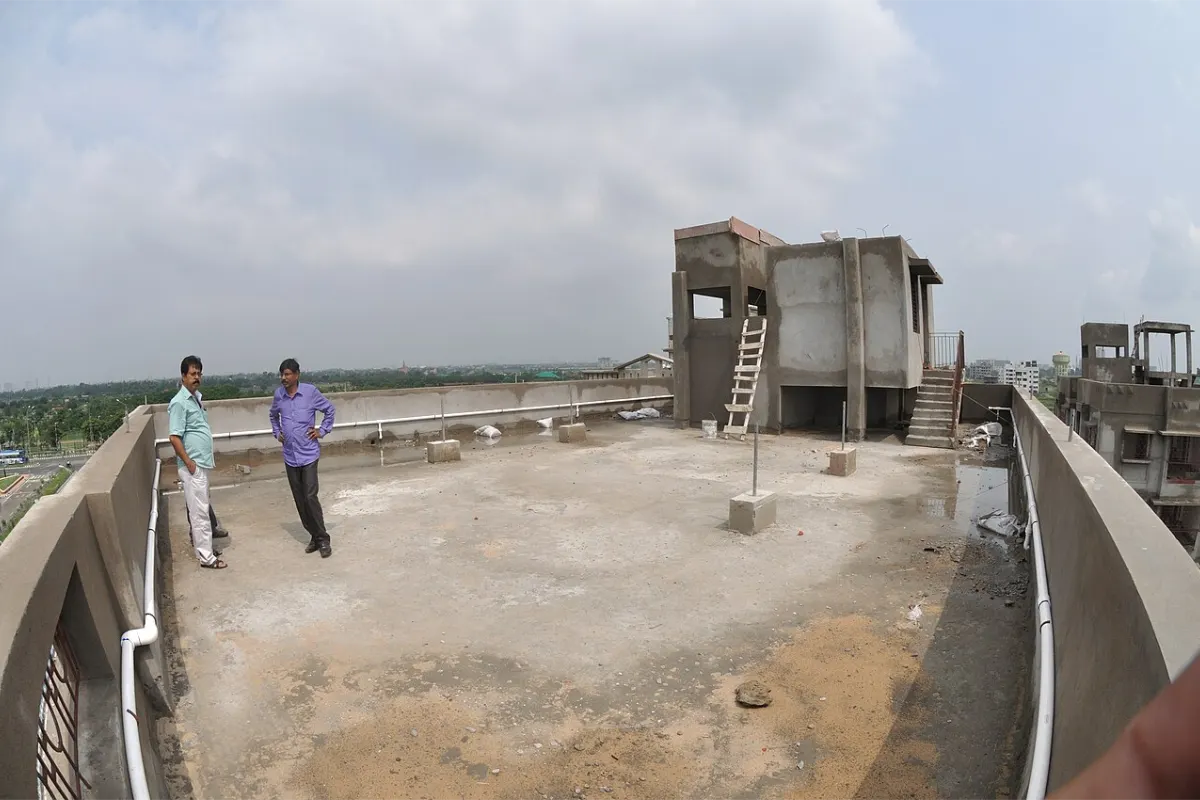
A stain on the ceiling marks where the water comes out, not where it went in. Water can travel inside a saturated screed for metres before it finds a crack in the slab. The first job is a survey: walk the roof after rain and look for ponding; check the parapet joints, outlets and pipes; tap the screed for hollow areas; look at the ceiling below and map the stains.
A moisture meter shows wet areas, and a section of screed can be opened to see whether the brick bat coba is soaked. A ceiling where new patches appear in different places after each storm usually means the screed is saturated and the water is moving inside it. A flood test, where a section of roof is ponded with water behind a temporary bund and the ceiling is watched for at least a full day, confirms a suspected area. Our Damp Diagnoser helps tell roof leaks from other kinds of damp.
The treatments and what each can do
Sealing a single crack or joint is a stopgap: it can stop a known leak for a season but does not deal with an aged roof. Elastomeric or acrylic coatings form a flexible skin; they need a sound, dry surface, and they wear in the sun and need recoating every few years. Cementitious and polymer-modified coatings bond well to concrete and suit some roofs, but they crack if the base moves. Liquid polyurethane membranes are tougher and more flexible but need careful application and protection from the sun.
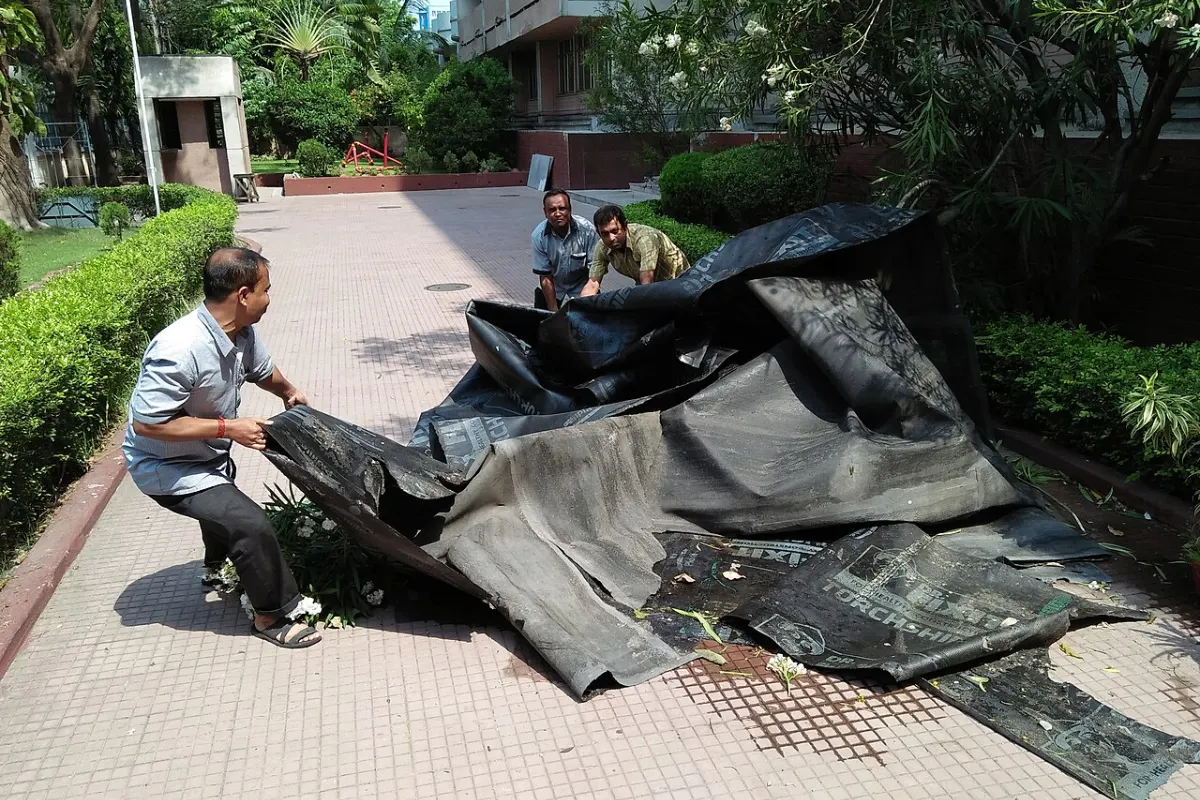
Sheet membranes, such as APP-modified bitumen laid with a torch or self-adhesive sheets, give a thicker, longer-lasting layer when the base is sound and the details are done with them. They need a protective layer, such as a screed or tiles, if the roof is used. When the brick bat coba is saturated, the slope is wrong or leaks keep moving, the lasting fix is to break out the old layers down to the slab, repair the slab, lay a new screed to proper falls with a membrane, and finish it. This costs more and takes longer, but it is the only fix that removes the wet sponge.
Choosing by the state of the roof
| What the survey finds | What usually works |
|---|---|
| One known crack or joint, roof otherwise sound and dry | Seal the crack or joint properly, then watch it through one monsoon |
| Hairline cracks over a sound, dry screed with a good slope | A flexible coating over the whole roof, with the parapet and outlet details |
| Wider cracks and open joints, screed still sound | A membrane system with its details, and a protective finish if the roof is used |
| Screed soaked, slope lost, or leaks that move from storm to storm | Break out to the slab, repair, re-screed to falls with a membrane |
| Old lime terrace with sound joists | Repair the lime terrace in lime, with a breathable finish; avoid sealing a damp lime roof under a cement coat |
| Lime terrace with rusted or rotten joists | A structural repair first, designed by an engineer, then the waterproofing |
The details decide the result
- Parapets: the waterproofing turns up the parapet by about 300 mm and is tucked into a groove or under a coping, so water cannot get behind it.
- Corners: the joint between roof and parapet is rounded with a fillet so the membrane does not crack at a sharp angle.
- Outlets: enough of them, set slightly below the roof surface, with a reinforced patch of waterproofing around each and a grating to stop leaves.
- Slope: the roof falls to the outlets everywhere, with no low spots. A flood test before the final finish shows where water stands.
- Pipes and supports: each penetration has its own collar or sealed sleeve; water tank and solar supports stand on plinths with the waterproofing turned up around them.
- Parapet tops: a coping that sheds water to the roof side, and sound plaster on the parapet walls.
- Expansion joints: a flexible seal that moves with the joint, not a rigid filler.

Reading a quotation
- Does it start with a survey, or with a product name?
- Does it say what happens to the existing layers: kept, repaired or broken out?
- Does it describe the parapet, outlet and pipe details, or only the area in square feet?
- Does it name the product, the number of coats or the thickness, and the surface preparation?
- Does it include a flood test before the finish, and who repairs any leak it finds?
- Does it say how long the treatment is expected to last, and what the maker's terms cover?
Timing and upkeep in Kolkata
Roof work needs dry weather. The months from November to March are the best; work in April and May has to allow for pre-monsoon storms, and most systems cannot be laid on a wet roof in the monsoon. If a roof is leaking in July, a temporary measure (clearing outlets, sealing the worst cracks, a tarpaulin) can carry it to the dry season, when the real repair can be done properly.
After the repair, keep outlets clear, especially before the monsoon and after leaf fall. Do not let water stand. Check the parapet joints and the coating once a year, and recoat a coating before it wears through. Avoid fixing new things through the roof without planning the seal: many good repairs are spoiled later by an antenna, a tank stand or a solar frame bolted straight through the membrane.

The options, honestly
| Treatment | Expected life | Right when… |
|---|---|---|
| Sealant patching | A season | Single identified joint/crack; stopgap before real work |
| Elastomeric coating | 2–4 yrs | Screed sound & dry, cracks hairline, budget tight |
| APP membrane | 7–10 yrs | Widespread cracking; screed sound; details (parapets, drains) redone with it |
| Break & re-screed + membrane | 15+ yrs | Screed saturated/spongy, slopes wrong, or ceiling patches keep migrating |
Details decide, again
- Every treatment must turn up the parapet 300mm and into a groove — terminations at floor level are pre-planned failures.
- Drain mouths get reinforced patches and gratings; slope must actually reach them (flood-test before final coat).
- A soaked screed can be confirmed simply: patches on the ceiling that keep appearing in new places mean water is travelling inside the screed — coatings above will not stop it.
Questions people ask
Why does the leak appear in a different place each time?
Usually because the screed or brick bat coba is saturated and water travels inside it before finding a crack in the slab. A coating on top will not stop that; the wet layer has to be dealt with.
Is a waterproof paint enough for an old roof?
Only if the roof is sound, dry and well sloped, with hairline cracks at most, and the details at parapets and outlets are done too. Over a soaked screed it fails quickly.
Can a roof be waterproofed during the monsoon?
Most systems need a dry surface, so the real repair usually waits for dry weather. Temporary measures can reduce leaks until then.
How long does roof waterproofing last?
It depends on the system, the preparation, the details and the upkeep. Coatings need recoating every few years; a membrane under a protective finish laid on a properly sloped screed lasts much longer.
Do you need to break the old terrace?
Not always. If the screed is sound and dry and the slope is good, it can stay. If it is soaked or the slope is lost, breaking it out is usually the only lasting fix.
Can you survey and repair an old roof?
Yes. We survey first, find where the water enters, recommend the treatment that suits the state of the roof, and carry out the work with its details and a flood test.
Red flags
- Quotes without any parapet/drain detail work
- Coating proposed over a roof with migrating ceiling patches
- No flood test after completion
Pro tip
Pay for one hour of diagnosis (moisture check, slope survey) before choosing a treatment — the most expensive waterproofing is the cheap one done twice.
Try it in our Lab: Monsoon Check
Seeing this at home? Roof leaking in the monsoon? Tick what you see and we tell you what it most likely means.
Sources
- IS 1346 Code of Practice for Waterproofing of Roofs with Bitumen Felts (Bureau of Indian Standards) (checked 15 Nov 2026)
- IS 2645 Integral Waterproofing Compounds for Cement Mortar and Concrete (Bureau of Indian Standards) (checked 15 Nov 2026)
- CPWD Handbook on Repair and Rehabilitation of RCC Buildings (checked 15 Nov 2026)
- India Meteorological Department: Kolkata climate and monsoon (checked 15 Nov 2026)
Checked against these sources on the dates shown, pending our team’s sign-off.