Site safety basics an owner should insist on
Safety on a small site isn't paperwork — it's five visible habits: helmets and proper footwear actually worn, sound scaffolding, no electrical leads through standing water, excavations barricaded, and materials stacked stable and clear of slab edges. As the owner you carry moral — and often practical — responsibility for accidents on your plot. A contractor casual about safety is casual about everything you can't see either.
Safety habits are the visible tip of a contractor's discipline — like a restaurant's washroom. You're allowed to judge the kitchen by it.
Building sites are among the most dangerous workplaces there are, and small sites, a house on a city plot, are not safer for being small. Falls from slab edges and scaffolds, objects dropped from above, electric shocks from site wiring, collapsing trenches and injuries from machines account for most accidents, and nearly all of them are prevented by a handful of visible habits.
As the owner you carry a moral and often a practical responsibility for what happens on your plot, and a contractor who is casual about safety is usually casual about the work you cannot see. This guide explains the main hazards and what good practice looks like for each, the law that applies, what changes with Kolkata's weather, what to write into the contract, and a quick scan you can do on every visit.
Why safety is your business
An accident on your site hurts a worker and a family first. It also stops the work, brings in the police and the labour authorities, and can lead to claims and disputes that last longer than the build. Owners are drawn in whether or not the contract says the contractor is responsible.
Since 21 November 2025, the safety duties that used to sit in the building workers' law are part of the Occupational Safety, Health and Working Conditions Code, 2020, and compensation for injured workers falls under the Code on Social Security, 2020. The contractor, as the employer, carries the legal duties on site. Your part is to choose a contractor who takes them seriously, to write them into the agreement and to notice when they are being ignored.
Falls: edges, openings, scaffolds and ladders
Falls from height cause more deaths in construction than anything else. On a house they happen from slab edges, through stair and lift openings, from scaffolds and from ladders, often from just one or two storeys.
- Edge protection on every slab edge above the ground floor: a guard rail at about waist to chest height, a mid rail and a toe board, as IS 4912 describes.
- Covers or rails over every opening in a slab: stairs, lift shafts, ducts and skylights.
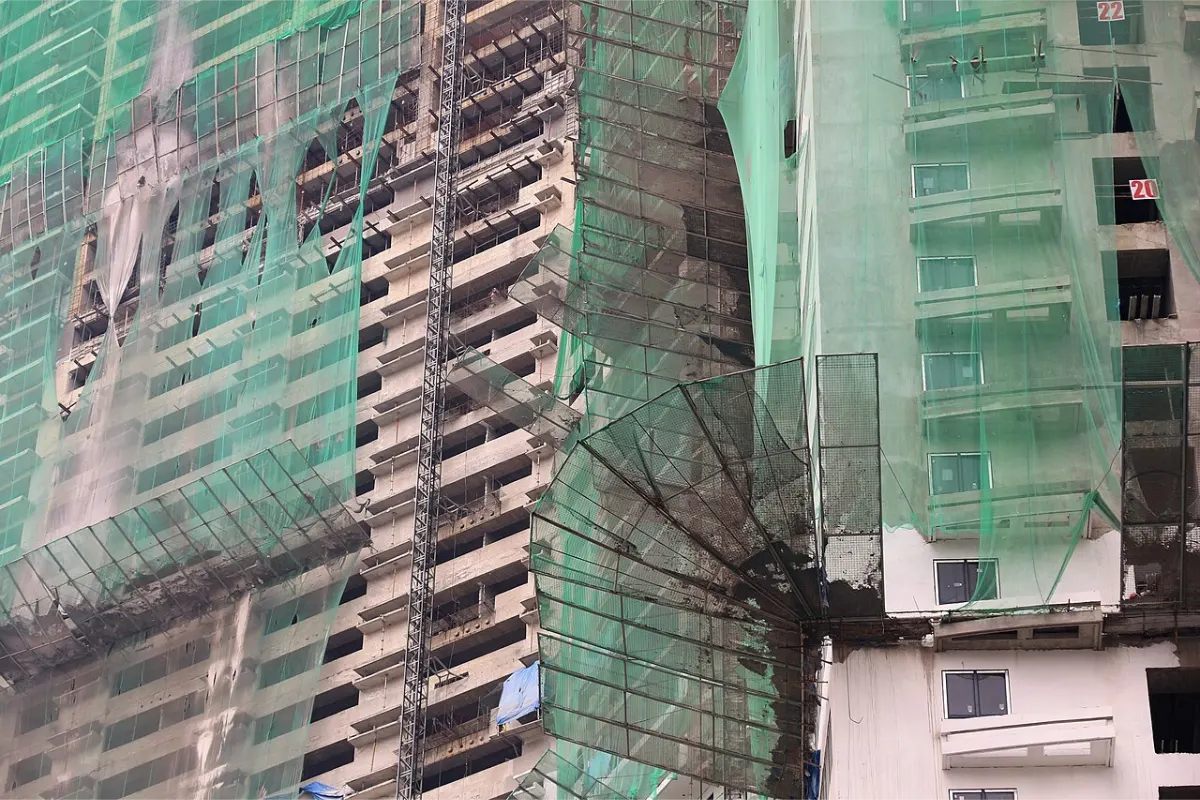
- Scaffolds built by experienced hands, braced and tied to the building, with full boards to stand on and rails at the working level. Bamboo scaffolding, common in Kolkata, can be safe when it is tied and braced properly, and dangerous when it is not.
- Ladders tied at the top, standing at about one out for every four up, and reaching about a metre above the landing.
- Safety harnesses clipped to a firm anchor wherever rails cannot be fixed, and safety nets under work at height where they can be hung.
Falling objects and head protection
Everyone below work at height is at risk from a dropped brick, a tool or an offcut of steel. Helmets save lives, but only if they are worn, fit and are of the right kind: industrial safety helmets to IS 2925, with the chin strap fastened.
- Helmets for everyone on site, including visitors and the owner.
- Toe boards on scaffolds and slab edges so nothing is kicked over.
- Debris brought down by chute or in containers, never thrown from upper floors.
- Materials stacked back from slab edges, never on scaffold boards beyond what the work needs.
- The area below loading and hoisting barricaded, with nobody standing under a load.

Electricity on site
Temporary site wiring kills people every year: cables trailing through puddles, taped joints, bare wires pushed into sockets and machines without an earth. A safe site has one proper distribution board with miniature circuit breakers and a 30 mA residual current device, heavy-duty cables run overhead or along walls rather than across the floor, proper plugs and sockets, and every mixer, vibrator and cutter earthed.
Kolkata's lanes add a hazard of their own: overhead power lines close to building fronts. Scaffolding, steel bars and aluminium ladders that come near a live line can kill. Keep everything well clear, and ask CESC or WBSEDCL to shroud or move a line before work starts close to it.
Excavations and the ground
Trenches and foundation pits collapse without warning, especially in Kolkata's soft clay and high water table. The excavation safety code, IS 3764, asks for the sides of excavations deeper than about 1.5 m to be shored or cut back to a safe slope.
- Shoring or sloped sides for any trench deeper than about 1.5 m, and earlier in soft or wet ground.
- Excavated soil and materials kept back from the edges, so their weight does not collapse the side.
- A ladder in every deep pit, so workers can climb out quickly.
- Barricades and lights around open pits at night.
- Pumps to keep pits dry, and a watch on neighbouring walls for new cracks.
Machines, materials and housekeeping
- Guards on cutters, mixers and saws; eye protection and dust masks for cutting tiles, stone and concrete, which give off silica dust.
- Gloves for handling cement and wet concrete, which burn and crack the skin.
- Caps or bends on protruding steel bars, so nobody falls onto them.
- Nails pulled from stripped formwork before it is stacked.
- Materials stacked stable and to safe heights, as IS 4082 and IS 7969 recommend.
- Walkways kept clear of offcuts, wire and debris.
- Fire extinguishers near welding and any gas cylinders, and no cooking near stored materials.
People: workers, families and the public
Safety is also about how people are looked after. Workers need drinking water, a toilet, shade and a first-aid kit, with protective gear given to them free of charge. Where workers live on site, their living area should be separate from the work, with safe cooking and lighting.
Children must not work on a building site; the law forbids it. Workers' children living nearby should be kept out of the work area altogether. The public needs protecting too: barricade the frontage, keep the footpath clear or provide a covered way past, hang nets or sheets on the facade where work goes on above the street, and light the site at night.
Kolkata's weather
- Heat: from April to June, give water, shade and rest, and move heavy work out of the hottest hours.
- Nor'westers from March to May and cyclone warnings later: tie down sheets and nets, brace scaffolds and stop work at height before the storm.
- Lightning: stop work on open roofs and at height during thunderstorms.
- Monsoon: slippery boards and ladders, water near cables, and pits that fill overnight; our monsoon guide covers the season.
- Mosquitoes: dengue peaks with the rains; empty curing ponds, drums and tanks at least once a week and keep containers covered.
What to put in the contract
- The contractor is responsible for safety on site under the law, for everyone on it.
- Protective gear provided free to every worker, and worn.
- Insurance for workers and third parties, with copies given to you before work starts.
- A named person on site responsible for safety each day.
- Every accident and near miss reported to you the same day.
- Your right, and your engineer's, to stop unsafe work until it is put right.
The sixty-second scan on every visit
You do not need to be an engineer to see whether a site is run safely. A quick look on every visit tells you most of what you need to know, and asking about what you see tells the contractor you are watching.
- Heads: is everyone wearing a helmet, under work at height and at it?
- Feet: proper shoes or boots, not slippers, in the work areas?
- Edges: rails or nets on every slab edge and opening above the ground floor?
- Power: one board with a residual current device, cables off the ground and out of water?
- Ground: pits barricaded and shored, walkways clear, bar ends capped?
- People: drinking water, a first-aid kit, and no children in the work area?
The 60-second safety scan on any visit
- Heads: helmets on everyone working at height or below it.
- Feet: shoes, not slippers, in active work areas.
- Power: one proper distribution board with an RCCB — not a spider's web of taped joints.
- Height: guard rails, nets or harnesses on slab edges above one storey.
- Ground: excavated pits barricaded, walkways clear of rebar offcuts.
Questions people ask
Is the owner responsible if a worker is hurt?
The contractor, as the employer, carries the legal duties for the workers' safety and compensation, and the agreement and insurance should say so. But owners are often drawn in, and the decent course is to make sure the site is safe before anyone is hurt.
Is bamboo scaffolding safe?
It can be, when experienced crews build it properly: tied and braced, with full boards and rails at the working level. Loose, untied or overloaded scaffolds of any material are dangerous.
Do workers need helmets on a small house?
Yes. Most falls and falling-object injuries happen from one or two storeys. A brick dropped from a first-floor slab can kill.
What should be on site in case of an accident?
A stocked first-aid kit, someone trained to use it, a phone list with the nearest hospital and an ambulance number, and a clear way for a vehicle to reach the site.
Can workers live on the site?
Often they do on Kolkata sites. If so, their living area should be separate from the work, with drinking water, toilets, safe cooking and lighting, and children kept out of the work zone.
How can you tell a contractor takes safety seriously?
Look at the site, not the brochure: helmets worn, edges railed, wiring tidy, pits shored, materials stacked. A contractor who keeps a safe site usually keeps a careful one.
Red flags
- Workers at slab-edge height with no rail, net or harness
- Electrical leads running through standing water
- Workers' children playing inside the active work zone
Pro tip
Safety compliance is written into our site inspections — the same checklist that verifies your concrete verifies the people building it.
Sources
- The Occupational Safety, Health and Working Conditions Code, 2020 and the Code on Social Security, 2020 (Ministry of Labour and Employment) (checked 15 Nov 2026)
- IS 2925 industrial safety helmets, IS 3696 scaffolds and ladders, IS 4912 floor and wall openings and railings (Bureau of Indian Standards) (checked 15 Nov 2026)
- IS 3764:1992 Code of Safety for Excavation Work and IS 7969 safety in the handling and storage of building materials (Bureau of Indian Standards) (checked 15 Nov 2026)
- National Disaster Management Authority: heat wave and thunderstorm guidance (checked 15 Nov 2026)
Checked against these sources on the dates shown, pending our team’s sign-off.