Wardrobe & cabinet hardware — the hinges that outlive the wood
In a modular wardrobe or kitchen, the boards get the attention but the hardware — hinges, drawer channels, handles — is what fails first and decides the daily experience. The two names to know: soft-close hinges and full-extension telescopic (or tandem) drawer channels. Cheap hinges sag and rattle within a year; good branded hardware runs smoothly for a decade. It's often the single best place to spend, and the easiest place for a contractor to quietly downgrade.
It's like a car: the body (boards) is what you see, but the engine and suspension (hardware) decide how it feels every day and whether it lasts. Nobody notices good hinges; everyone notices a door that sags and a drawer that sticks.
Modular wardrobes and kitchens are built from two things: boards and hardware. The boards decide how a unit looks on the day it is handed over. The hardware, the hinges, drawer runners, lift-up fittings and sliding tracks, decides how it feels every day after that, and whether the doors still close square in five years. It is also the easiest place for a quote to lose quality without anyone noticing at handover, because a cheap hinge and a good one look much the same on the first day.
This guide explains the main kinds of hardware and what to ask for, how hinges and runners are rated, sliding wardrobe systems, kitchen fittings, how the board and the hardware work together, what Kolkata's humidity does, how to write the hardware into a quote, and the checks at handover. Our plywood grades guide covers the boards.
The hardware in a modular unit
| Part | What it does | What to ask for |
|---|---|---|
| Hinges | Hold and swing the doors | Concealed hinges from a named maker, soft-close, with the right number per door |
| Drawer runners | Let drawers slide in and out | Full extension, soft-close, with a load rating suited to the drawer |
| Drawer systems | Ready-made drawer sides with built-in runners | A named system and its load class, for heavy kitchen drawers |
| Lift-up fittings | Hold overhead kitchen doors open | A fitting rated for the door's weight, which stays where you leave it |
| Sliding door systems | Carry and guide sliding wardrobe doors | A named system rated for the door size and weight, soft-close both ways |
| Kitchen fittings | Baskets, corner units, tall pull-outs, bins | Stainless steel where wet, rated loads, smooth runners |
| Connectors and supports | Join boards, hold shelves, level the units | Proper connectors and adjustable legs that keep kitchen units off a wet floor |
| Handles and profiles | Open doors and drawers | Firm fixing; profiles that suit the door thickness |
Hinges
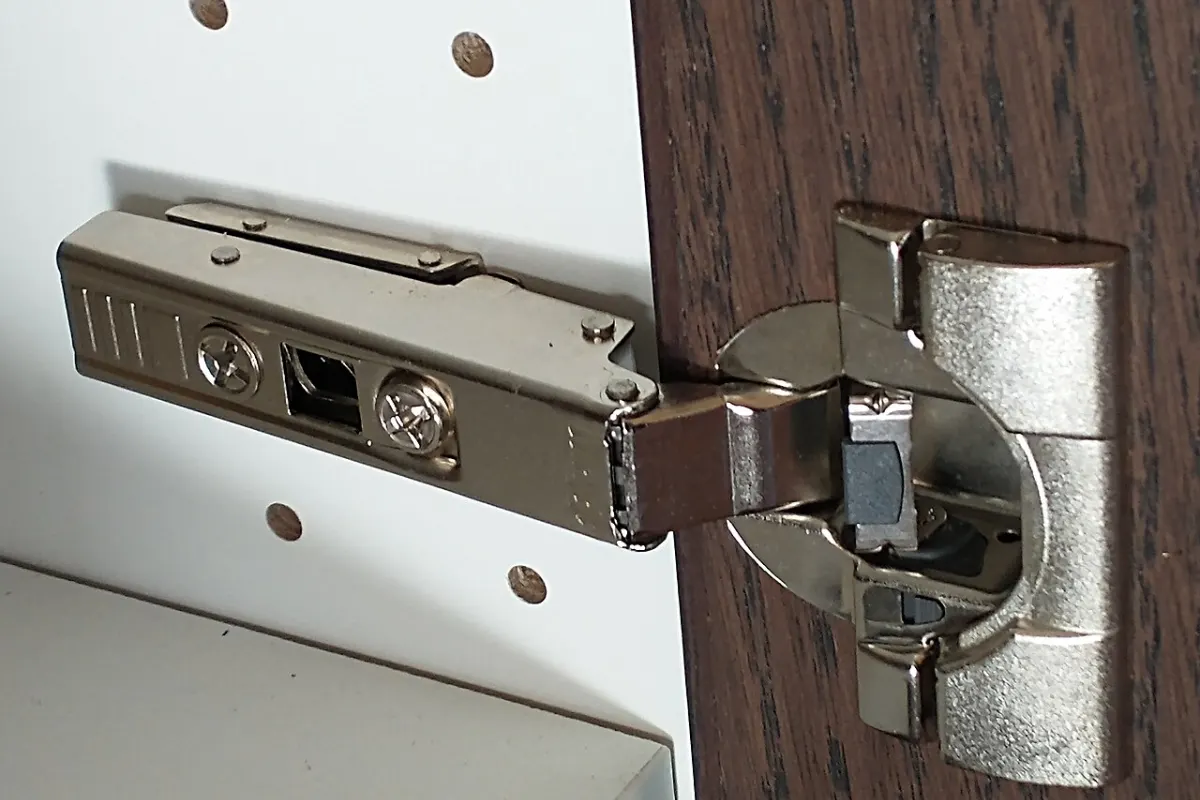
Most modular furniture uses concealed hinges, the kind with a round cup set into the back of the door, commonly 35 mm across, and an arm that clips onto a mounting plate inside the cabinet. The type of arm depends on where the door sits: full overlay, covering the cabinet's side; half overlay, sharing a side with the next door; or inset, sitting inside the frame. Most open to about 95 to 110 degrees; wide-angle hinges open further, for corner units and doors that must clear internal drawers.
Good hinges adjust three ways, side to side, up and down, and in and out, so doors can be aligned after fitting and again after the cabinet settles. Soft-close dampers, built into the hinge or added on, stop doors slamming. Taller and heavier doors need more hinges: hinge makers' charts typically suggest two for doors up to about 900 mm high, three up to about 1,600 mm, four up to about 2,000 mm and more beyond, with extra for wide, heavy or mirrored doors. Too few hinges is the commonest cause of sagging wardrobe doors.

How hardware is rated
Good hardware makers test their hinges and runners for strength and for thousands of opening cycles, often to European standards such as EN 15570 for hinges and EN 15338 for drawer runners, and publish load ratings and cycle counts. Ask for these figures, not only the brand. A drawer runner rated for a light load will sag and grind under a drawer full of steel vessels, however good its brand.
Drawer runners and systems
The common types are ball-bearing telescopic runners, fixed to the sides of the drawer and visible when it is open; concealed undermount runners, hidden beneath the drawer, usually with soft-close built in; and complete drawer systems with metal sides and runners made together. Full extension, where the drawer comes all the way out, lets you reach the back; three-quarter extension leaves the back of the drawer inside the cabinet.
Runners come in load classes. Kitchen drawers holding vessels, plates and grain need a higher rating than a wardrobe drawer of clothes. Wide drawers need a synchronising bar so both sides run together and the drawer does not twist. Push-to-open fittings allow handle-free fronts, but work best with good-quality runners.
Sliding wardrobes
Sliding doors save the space a swinging door needs. Systems are either top-hung, with the doors hanging from rollers in a top track and guided at the bottom, or bottom-rolling, with the weight on rollers in a floor track and guidance above. Each system has limits on door height, width and weight; a tall mirrored door can be heavier than the system allows. Look for soft-close at both ends, stops that keep the door from jumping off the track, and doors that are stiff and flat, because tall doors in poor board warp and then bind.
Bottom tracks collect dust and need cleaning. The ceiling and floor should be level for the doors to run true, and the wardrobe needs extra depth to fit the track in front of the carcass.
Kitchen fittings
- Lift-up fittings for overhead cabinets are rated by the weight and size of the door; one too weak lets the door drift down, one too strong slams it up.
- Corner fittings, such as swing-out shelves and carousels, carry a stated load per shelf; check it against what you plan to keep there.
- Tall pull-out larders need strong runners and a firm fixing to the floor or wall.
- Baskets and racks near the sink should be stainless steel, such as grade 304; chrome-plated mild steel rusts in a humid kitchen.
- The cabinet under the sink needs hardware that tolerates damp, and a waterproof base.
- Cabinets beside an oven or hob need fittings that tolerate heat.
The board matters too
A hinge or runner is only as strong as the board its screws go into. Screws hold best in plywood; in particle board and MDF they strip out more easily, so makers use larger screws, inserts or dowels. Many sagging doors and loose drawers are really board failures. For kitchens, especially around the sink, boiling water proof plywood to IS 710, often called marine plywood, resists swelling; for dry wardrobes, moisture-resistant plywood to IS 303 is common. Every cut edge should be sealed with edge banding, because moisture enters through raw edges.
Humidity and rust in Kolkata
Kolkata's long humid season and the monsoon are hard on furniture. Plated steel fittings rust, especially in and under the sink, and the rust spreads to screws and runners. Boards swell at unsealed edges, which throws doors out of line. Wardrobes built against outside walls that get damp in the rains can grow mould behind and inside them.
Choose stainless or well-finished fittings where it is wet, seal every edge, and leave a small air gap behind wardrobes on outside walls. Before building a wardrobe against a wall, make sure the wall itself is dry; our damp guide explains how to find the source of a damp wall.
Writing it into the quote
- The maker and the model or series for each type of hinge, runner, lift-up and sliding system.
- Soft-close: yes or no, for doors and drawers separately.
- Runner type, extension and load rating for kitchen drawers.
- The number of hinges per door, at least for the tall wardrobe doors.
- Material and finish, especially stainless steel for wet areas.
- The board for each part, with its standard.
- Who adjusts the doors and drawers after the first few months, and what the maker's warranty covers; ask for the warranty card.
Imported hardware with no maker or model named is where substitutions hide. Naming the maker and model in the quote, and checking them at handover, is your only real protection.
Checks at handover
- Open and close every door several times: it should close softly without slamming, and stay closed.
- Look at the gaps between doors: even, straight and the same top to bottom. Uneven gaps can be adjusted at the hinges, so ask for it then.
- Pull every drawer fully out and press down on its front: it should not tilt, rub or grind.
- Load a kitchen drawer with a few heavy vessels and run it in and out.
- Try each lift-up door at different heights: it should stay where you leave it.
- Run each sliding door end to end: smooth, quiet, soft-closing at both ends, and not lifting off the track.
- Check the maker's marks stamped on the hinges and runners against the quote.
- Check that all screws are in, none stripped, every edge is banded, and the handles are firm.
What to specify and check
- Hinges: soft-close, from a named brand — open and shut every door at handover; they should close quietly without slamming or sagging.
- Drawers: full-extension telescopic or tandem channels rated for load — pull each fully out and press down; it shouldn't tilt or grind.
- Get the hardware brand and model in writing in your quote — 'imported hardware' with no name is where the downgrade hides.
The quiet substitution
A common trick: quote branded hardware, install look-alike unbranded fittings you can't tell apart on day one. Because hardware failure shows up months later, it's rarely traced back. Naming the brand in the contract and checking at handover is your only real protection.
Questions people ask
Is soft-close hardware worth it?
Yes, for most homes. It stops doors and drawers slamming, reduces wear on the hinges, the boards and whatever is inside, and makes the furniture feel better made every day.
How many hinges does a tall wardrobe door need?
Follow the hinge maker's chart. As a typical guide, about four hinges for a door around 2 m tall, and more for wide, heavy or mirrored doors.
Why do wardrobe doors sag?
Usually too few hinges, cheap hinges, screws pulled out of a weak board, or a door that has warped. Adjusting the hinges fixes small sags; the cause decides the rest.
Are sliding wardrobes better than hinged ones?
They save the floor space a swinging door needs, which helps in small bedrooms. Hinged doors give full access to the wardrobe at once and are simpler to maintain. A sliding system must be rated for the door size and weight.
How can you check that the hardware in the quote was installed?
Most makers stamp their name or mark on hinges and runners. Compare them with the maker and model named in the quote at handover, before the final payment.
Do hinges and runners need maintenance?
A little. Doors often need a small adjustment after the first few months. Keep runners and tracks clean, and do not oil soft-close dampers, which can damage them.
Red flags
- 'Imported hardware' quoted with no brand or model named
- Doors that sag or drawers that grind at handover
- Hardware brand in the quote differing from what's installed
Pro tip
Good hardware is invisible and lasts; bad hardware is a daily irritation you paid for. We specify named, load-rated hardware in writing and verify it at installation — the part most quotes leave deliberately vague.
Sources
- EN 15570 Hardware for Furniture: Strength and Durability of Hinges, and EN 15338 Hardware for Furniture: Strength and Durability of Extension Elements (CEN) (checked 15 Nov 2026)
- IS 710 Marine Plywood, Specification (Bureau of Indian Standards) (checked 15 Nov 2026)
- IS 303 Plywood for General Purposes, Specification (Bureau of Indian Standards) (checked 15 Nov 2026)
Checked against these sources on the dates shown, pending our team’s sign-off.