Stamp duty and registration in West Bengal: the rates, the rebates and the steps
What you pay at the registry office, which rebates apply, and the papers to carry, checked against the state’s own notices.
By Raj Sekhar Ghosh, Editor. Published 2026-11-20.
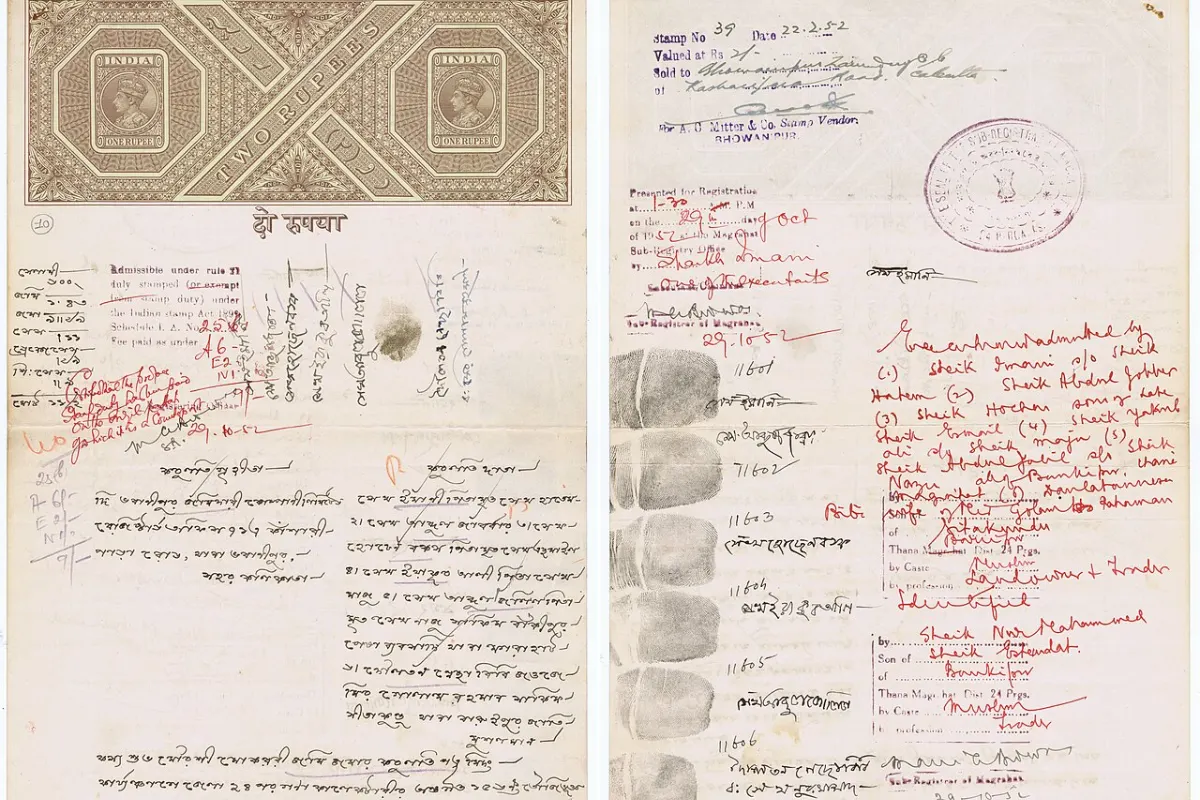
Key points
- In Kolkata and the other municipal areas, stamp duty on a sale is 6% of the value up to ₹1 crore and 7% above it. In panchayat areas it is 5% and 6%.
- Registration fees come to about 1% of the value, with small fixed charges for copies and processing.
- Duty is charged on the higher of the price in the deed and the market value the registration office sets for the property.
- No rebate is in force: the state ended the 2% cut in stamp duty and the 10% cut in market values from 1 July 2024. There is no lower rate for women buyers.
- You start online on the e-Nathikaran portal, pay through GRIPS, book a slot, and sign at the registry office, where photos and fingerprints are taken.
- On a deed valued at ₹50 lakh in Kolkata, that is ₹3,00,000 in stamp duty and about ₹50,000 in registration fees.
The rates
Stamp duty is a state tax on documents, collected with the registration of the deed by the Directorate of Registration and Stamp Revenue. On a sale of land, a house or a flat in Kolkata and the other corporation and municipal areas, it is 6% of the value up to ₹1 crore and 7% above ₹1 crore. In panchayat areas each rate is a point lower: 5% and 6%. Registration fees come to about 1% of the value on top, with small fixed charges for copies and processing.
Other documents carry their own rates: gifts within the family, partitions, leases, development agreements and powers of attorney are each charged differently. Our Stamp Duty and Registration calculator works out a sale; for any other document, ask the registration office or your lawyer for the figure before the day.
What the duty is charged on
The registration office sets a market value for every property from its own rates for the area, the kind of property and its size. Duty and fees are charged on that value or on the price in the deed, whichever is higher. The e-Nathikaran portal shows the assessed value and the amounts due before you pay.
So writing a lower price in the deed rarely saves duty, and it costs in other ways: the difference is usually paid in cash with no proof, income tax treats a sale below the government’s value as made at that value, and a bank lends against the lower figure. Our guide to stamp duty, registration and GST explains which taxes apply to which kind of deal.
The rebates: what has ended
During the pandemic years the state cut stamp duty by 2% and the market values used for duty by 10%, to keep property sales moving, and extended the cuts several times. Both were discontinued with effect from 1 July 2024, as the Directorate’s own notice says. A deed registered now pays the full rates above.
Unlike some other states, West Bengal has no lower stamp duty for women buyers. If a seller or an agent quotes a figure that assumes either rebate, ask them to show the notice that allows it.
The steps, from the portal to the registry office
Start on the e-Nathikaran portal of the Directorate of Registration and Stamp Revenue: fill in the e-requisition with the deed’s details, the parties and the property, and pick the registration office for the area. The portal gives a query number, the assessed market value, and the stamp duty and fees due.
Pay against that query number through GRIPS, the state’s online payment system; payment online is compulsory when the duty is more than ₹10,000 or the fees more than ₹5,000. Then book an appointment at the registry office with the same number.
On the day, the buyer and the seller (or their attorneys) present the deed in person. The office checks the papers and the PAN of the parties, takes each person’s photo, fingerprints and signature, and scans the deed. After registration, apply for mutation so that the municipality’s records show you as the owner; our guide to mutation and property tax explains that step.
What to carry
The deed as drafted and checked by your lawyer; the query number and the assessment slip; the GRIPS payment receipts; identity proof and PAN for every party; recent photographs; and the documents behind the deed: the previous deed and the chain of title, the latest property tax receipt and the mutation record, and for a flat the completion certificate and the promoter’s authority. A missing paper usually means another appointment.
What this means for you
- Buying a flat in Kolkata: budget about 7% over the deed value for stamp duty and fees, or 8% above ₹1 crore.
- Before you pay an advance: check the market value on the portal, so that you know the duty before you agree the price.
- Buying land to build on: stamp duty applies to the land deed; GST comes later, on the contractor’s work.
- Keep the query number, the GRIPS receipts and the registered deed together: you need them for mutation and for the bank.
Sources
- Directorate of Registration and Stamp Revenue, West Bengal: e-Nathikaran (notices: the 2% remission and the 10% circle-rate cut discontinued from 1 July 2024; e-payment compulsory above ₹10,000 duty or ₹5,000 fees; e-appointment) (checked 2026-11-15)
- Directorate of Registration and Stamp Revenue, West Bengal (checked 2026-11-15)
- GRIPS, Government of West Bengal online receipts (checked 2026-11-15)
- The Indian Stamp Act, 1899, as applied in West Bengal, and The Registration Act, 1908 (India Code) (checked 2026-11-15)
Check it yourself
- Stamp Duty & Registration calculator: Your property’s value and area give the West Bengal stamp duty and fees.
- Stamp duty, registration and GST: The taxes around your property, mapped for each kind of deal.

