Why 40-year-old RCC fails — carbonation, chlorides and rusting rebar
Concrete protects steel with alkalinity. Over decades, CO₂ soaks in (carbonation) and neutralises that protection; near coasts or from contaminated sand, chlorides do it faster. Then rebar rusts, rust expands 4–6×, and the expanding rust cracks and pops the cover concrete — the spalling you see on old Kolkata buildings. The visible flaking is the last chapter, not the first.
Concrete cover is the peel on a fruit. Carbonation is the peel thinning invisibly for 30 years; the brown patch you finally see means the inside has been exposed for a while.
Walk through any older neighbourhood in Kolkata and you will see it: balcony slabs with brown streaks and bare rusted bars, beams with chunks of concrete missing, sunshades held up more by habit than by steel. Most of these buildings were not built badly by the standards of their time. They are showing the most common way reinforced concrete ages, which is the slow loss of the protection that concrete gives to the steel inside it.
This guide explains how concrete protects steel, how carbonation and chlorides break that protection, why Kolkata's climate and older building practices make it worse, how engineers measure it, what repair means at each stage, and how to slow it down in a building that is still sound. Our Corrosion Estimator in the Lab shows when the rust is likely to reach the bars in your building, and our Rebar Cover Checker shows the cover the code asks for.
How concrete protects steel
Fresh concrete is strongly alkaline. In that alkaline environment, a thin, stable film forms on the surface of the steel bars and stops them from rusting, even though the concrete around them is damp. As long as the concrete around the bar stays alkaline and free of salts, the steel stays protected.
The layer of concrete between the bar and the surface is called the cover. It is the steel's only defence against air, water and salts. IS 456 sets the nominal cover by exposure condition (Table 16): the more severe the exposure, the more cover and the better the concrete it asks for. A bar with too little cover, or in porous concrete, loses its protection far sooner.
Carbonation: the slow front
Carbon dioxide in the air reacts with the alkaline compounds in concrete and lowers its alkalinity. This is carbonation. It starts at the surface and moves inward as a front, fast at first and then more slowly. When the front reaches the bars, the protective film breaks down and the steel can begin to rust, provided there is moisture and oxygen.
How fast the front moves depends mainly on the quality of the concrete and on the moisture. Dense, well-cured concrete with a low water content carbonates slowly; weak, porous concrete with too much water and poor curing carbonates fast. Concrete that is either always dry or always saturated corrodes slowly; concrete that is wetted and dried in cycles, as Kolkata's humid air and monsoon do to exposed parts, corrodes fastest once the front arrives.
Chlorides: the faster attack
Chloride salts break the protective film even while the concrete is still alkaline, and they cause pitting, where the bar is eaten away in deep local spots that can cut its section badly before much rust shows. Chlorides come from sea air near the coast, from salty sand or water used in the mix, from some old admixtures, and from salty groundwater rising into foundations and ground-floor columns. IS 456 limits the chloride content of new concrete (Table 7), and it does not allow sea water for reinforced concrete.
In Kolkata the sea is far enough away that sea air matters less than in coastal cities, but chlorides still appear: in older buildings where unwashed or estuarine sand was used, in ground-floor members wetted by salty soil water, and where repairs used unknown materials.
Why rust breaks concrete
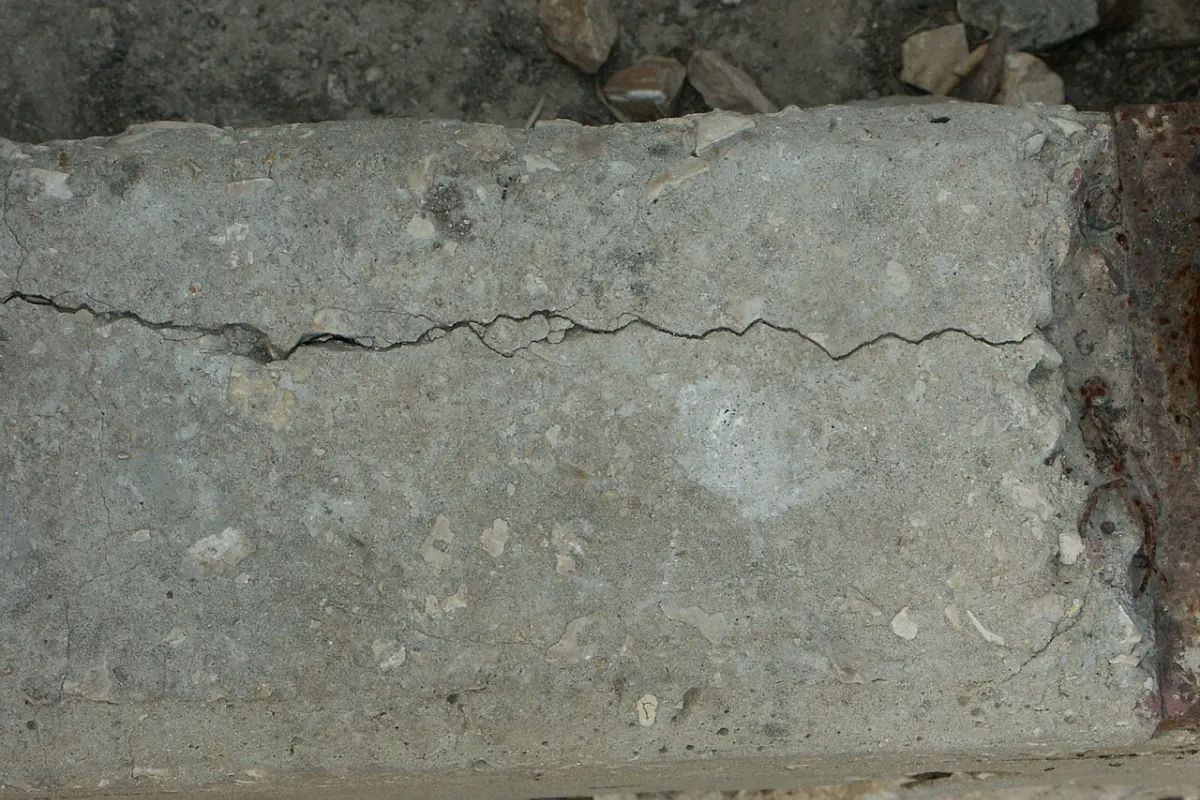
Rust takes up several times the volume of the steel it comes from. As it forms, it pushes against the concrete around the bar until the cover cracks along the line of the bar. The cracks let in more water and air, the rust speeds up, and finally the cover breaks away. This is spalling.
The visible damage comes late. By the time cracks follow the bars or the concrete sounds hollow when tapped, corrosion has usually been going on for years. The steel loses section, its bond with the concrete weakens, and in time the member carries less load than it was designed for. Stirrups and links, being thin, are often the first to rust through.

Why older Kolkata buildings suffer
- Thin cover: much older construction has far less cover than today's code asks for, sometimes only a centimetre or two at the bottom of slabs and sunshades.
- Weak, porous concrete: hand mixing, too much water for workability, and little curing produced concrete that carbonates fast.
- Humidity and wet-dry cycles: months of humid air, the monsoon and the dry season keep exposed concrete cycling through the conditions in which corrosion runs fastest.
- Leaks: water from roofs, bathrooms and broken pipes keeps parts of slabs and beams wet for years.
- Thin members exposed on several sides: balconies, sunshades and parapets carbonate from more than one face.
- Additions and neglect: floors added on old frames, plaster removed and never replaced, cracks left open.
How engineers measure it
The key comparison is between the carbonation depth and the cover. If the front is still well short of the bars, the steel is protected for now and the aim is to keep it that way. If the front has passed the bars, or chlorides at the bars are high, corrosion is likely or under way.
| Test | What it shows |
|---|---|
| Visual survey and hammer tapping | Cracks along bars, rust stains, spalling and hollow-sounding cover |
| Carbonation depth (indicator spray on a fresh break or core) | How far the carbonation front has moved, compared with the cover |
| Cover meter | Where the bars are and how much concrete covers them |
| Half-cell potential | Where the steel is likely to be actively corroding, before damage shows |
| Chloride content from drilled powder or cores | Whether chlorides at the bar depth are high enough to cause corrosion |
| Cores and rebound or pulse velocity tests | The strength and quality of the concrete itself |
| Breaking out a small area | The actual state of the bars and how much section is lost |
Repair at each stage
Early, when the front has not yet reached the bars and the concrete is sound: stop the leaks, close cracks, and apply an anti-carbonation coating, which slows the entry of carbon dioxide and water. This is the cheapest stage and the one most often missed.
Active corrosion in patches: break out the damaged concrete well behind the bars, clean the bars to bright steel, add new bars where section is lost (designed by the engineer), apply a protective coating to the steel where the system calls for it, and rebuild the cover with a repair mortar or micro-concrete of good quality and enough thickness, then coat the surface. Patching only the broken spot while leaving rusting bars on either side leads to new spalls beside the repair, which is why the same spots fail again and again.
Widespread corrosion with significant loss of steel: the member needs strengthening, such as column jacketing, extra beams or other measures, designed by a structural engineer after an assessment. At this stage surface repairs alone do not restore the load the member can carry. Our guides to spalling, column jacketing and structural audits explain these steps.
Slowing it down in a sound building
- Keep water out: fix roof and bathroom leaks, broken pipes and blocked outlets quickly.
- Keep plaster and paint intact on concrete surfaces; do not leave beams and slabs bare.
- Close cracks before the monsoon.
- Have exposed parts checked every few years: balconies, sunshades, parapets, ground-floor columns and the roof.
- Have a condition survey once an RCC building reaches about 30 to 35 years, or earlier if rust stains appear.
- In new work, insist on the cover the code requires, cover blocks of the right size, a dense mix with little water, and proper curing.
How the diagnosis is actually done
- Carbonation depth: a pH indicator spray on a freshly broken edge shows exactly how deep the neutral zone has advanced — engineers compare it with the cover depth.
- Cover survey: a covermeter maps how much concrete actually protects the bars (old construction often has 10–15mm where 40 was needed).
- Half-cell potential: an electrode survey maps where bars are actively corroding before anything is visible.
- Core tests: strength plus chloride content, telling whether the concrete itself is still sound.
What repair means at each stage
Caught early (carbonation approaching but not past the bars): anti-carbonation coatings buy decades. Active corrosion in patches: break out, clean or supplement bars, polymer-repair, and coat. Widespread section loss: jacketing or structural strengthening, designed — at that point patch repairs are cosmetics on a load problem.
Questions people ask
What does the brown stain on a beam mean?
Usually that the steel inside is rusting and the rust is bleeding through the concrete. It should be checked, because the corrosion has likely been going on for some time.
Can a carbonated building be saved?
Usually, yes. Caught early, coatings and leak repairs slow it a great deal. With active corrosion, proper patch repairs work. With heavy steel loss, the members need strengthening, designed by an engineer.
Why does the same spot keep spalling after repair?
Often because only the broken part was patched while rusting bars around it were left, or because the repair was too thin or the leak behind it was never fixed.
How is carbonation tested?
An indicator solution is sprayed on a freshly broken surface or core. Uncarbonated concrete turns colour; carbonated concrete does not. The depth is compared with the cover over the bars.
Is painting enough to protect old concrete?
An anti-carbonation coating on sound concrete helps a lot. Ordinary paint over cracks, rust or hollow concrete does not stop corrosion that has already started.
Do you carry out condition surveys and repairs?
Yes. Our engineers survey the building, test where needed, and design and carry out the repairs that suit its stage.
Red flags
- Rust stains bleeding through paint on beams and slab soffits
- Cover concrete that sounds hollow over large areas
- Repairs done repeatedly at the same spots every few years
Pro tip
For any RCC building past ~35 years, a condition survey (carbonation + cover + half-cell) prices at a fraction of one flat's repainting and tells you the building's real age — biological, not calendar.
Work it out: Rebar Cover Checker
Sources
- IS 456:2000 Plain and Reinforced Concrete, Code of Practice (Tables 7 and 16) (Bureau of Indian Standards) (checked 15 Nov 2026)
- IS 516 Methods of Tests for Strength of Concrete, including non-destructive testing (Bureau of Indian Standards) (checked 15 Nov 2026)
- CPWD Handbook on Repair and Rehabilitation of RCC Buildings (checked 15 Nov 2026)
- The Concrete Society (UK): corrosion of steel in concrete (checked 15 Nov 2026)
Checked against these sources on the dates shown, pending our team’s sign-off.