Land conversion in West Bengal: Sali to Bastu before you build
If your plot’s Record of Rights shows it as farmland (sali or another agricultural class) or a pond, you need the Collector’s written permission to change its use before you build: section 4C of the West Bengal Land Reforms Act, 1955. Land already recorded as bastu or viti is non-agricultural and needs no conversion. You apply on Banglarbhumi once the record is in your name; the land office checks the plot and issues an order, and the plan sanction comes after it.
Your plot has a job description in the government’s record. Conversion is the formal change of job, signed before the new work starts, not after.
In West Bengal, every plot carries a class in its Record of Rights: homestead, paddy, pond, orchard and so on. The class is not just a description. The West Bengal Land Reforms Act, 1955 asks every holder to keep land to the use it is recorded for, unless the Collector permits a change in writing. A plot recorded as paddy land or a pond cannot lawfully carry a house until that permission, known as conversion, has been granted.
This guide explains why the class matters, which plots need conversion and which do not, who decides, how to apply, what the inquiry looks at, what is special about ponds and other water bodies, what happens if a house is built before conversion, how conversion fits with the building plan and the loan, and the mistakes to avoid. It is general information drawn from the Act and the department's published procedures; your district's land office has the final word on your plot.
Why the class matters
Land in West Bengal was settled and recorded for particular uses, and the state controls changes of use to protect farmland, water bodies and the people who depend on them. Section 4B of the Act asks every raiyat, the holder of the land, to keep it to the use it was settled or held for, and section 4C lets the Collector permit a change in writing. Changing the use without permission is an offence under section 4D.
For anyone planning a house, the class decides whether there is an extra step before the plan can be filed. Municipalities and panchayats ask for the land's class when they consider a building application, and banks read it before they lend. A plot recorded as farmland or a pond holds up all of these until it is converted.
Which plots need conversion
Read the class in the plot's Record of Rights. Bastu and viti are homestead classes and are non-agricultural, so a plot already recorded as either needs no conversion for a house. Sali, the class for paddy land, and other agricultural classes need conversion before a non-agricultural use. Ponds and other water bodies need conversion with extra safeguards, described below. Our guide to reading your land record explains how to find the class.
| Class in the record | Before you build a house |
|---|---|
| Bastu or viti (homestead) | No conversion needed |
| Sali or another agricultural class | Conversion under section 4C |
| Pond or any other water body | Conversion only after the Collector consults the state department named in the rules; the order may require a replacement water body |
The class in the record is what counts, not how the land looks today. A plot that has been a garden or an empty lot for years may still be recorded as sali, and one that was filled long ago may still be recorded as a pond. Check the record, not the ground.
Who decides
The Collector decides, or the land officers appointed to act for them. Which officer handles a plot depends on its area and is set by notification, so it can differ between districts and change over time. Paschim Medinipur district, for example, lists the Block Land and Land Reforms Officer (BL&LRO) for plots up to 10 decimals and the Sub-Divisional Land and Land Reforms Officer (SDLLRO) for 11 to 99 decimals. Check your district's land department page, or ask at the BL&LRO office, before you apply.
Before you apply
Conversion is granted to the holder recorded in the Record of Rights, so the record must be in your name before you apply. If you have just bought the plot, or inherited it, that means mutation first. The land revenue, khajna, should be paid up. And the papers should agree with each other: the deed, the record and the plot on the ground.
- The Record of Rights in your name, after mutation.
- Land revenue paid up to date.
- Your registered deed and the chain of title.
- The district, block, mouza, khatian and dag numbers, and the plot map.
- The present class and the use you want, with the area to be converted.
- Identity and address proof, as the portal asks.
The steps
Applications are made online on Banglarbhumi, the state's land records portal, or at a Common Service Centre. The portal works out the fee from the land's class and area, and lets you track the application. The department's published procedure runs as below; times vary by district and workload.
- Apply on Banglarbhumi (Citizen Services, Online Application, Conversion Application) or at a Common Service Centre, with the plot details, the present class and the use you want. Keep the application number.
- Pay the fee shown by the portal, which depends on the class and area.
- The land office inquires: an officer checks the record, visits the plot, and the people interested in the land can be heard before the order.
- The written order either permits the change, on conditions, or rejects it, with reasons.
- Track the order on Banglarbhumi with the application number, and download or collect it.
- Check that the Record of Rights now shows the new class, and keep the order with your deed.
What the inquiry looks at
The inquiry checks that the applicant is the recorded holder, that the plot is what the application says it is, and that the change is allowed. The officer may look at the use of the land around it, the access to it, whether it is part of a larger agricultural holding, whether anyone else holds rights in it, such as a recorded bargadar, and, for water bodies, the effect of filling it. Conditions in the order can cover the use, the area and, for water bodies, a replacement.
Ponds and water bodies
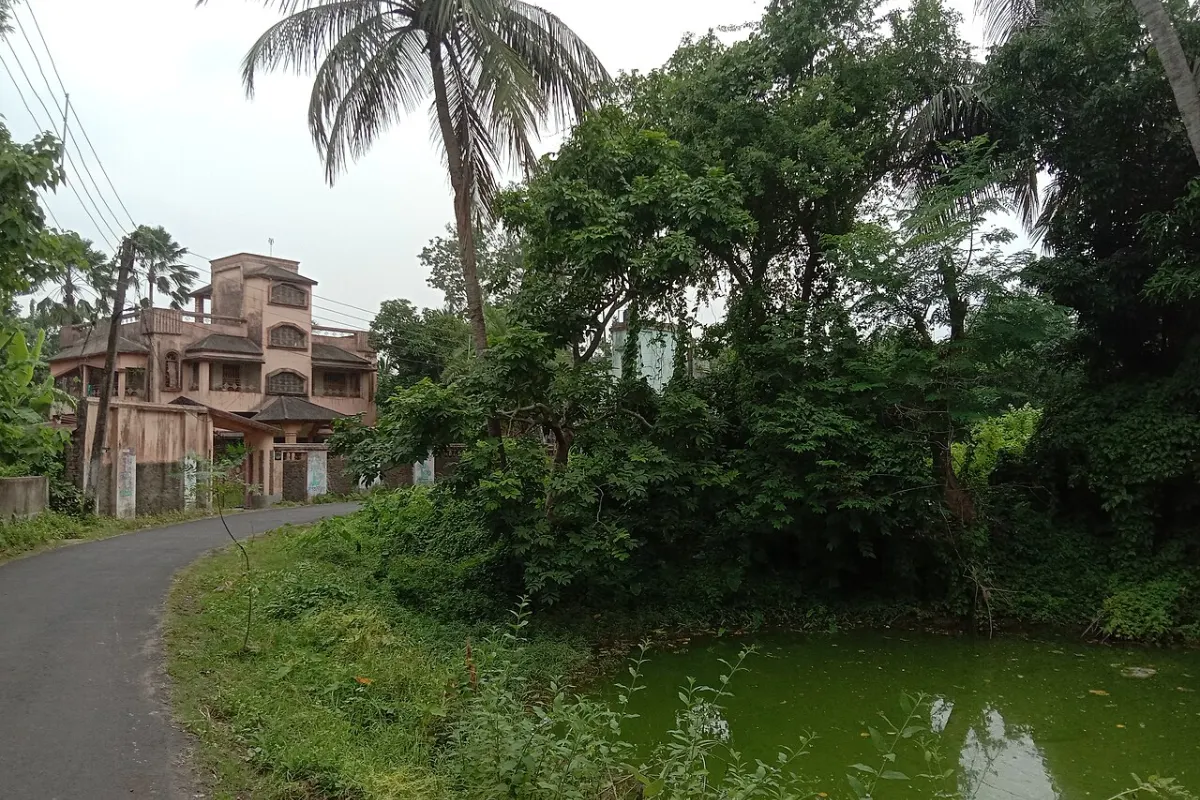
Ponds, tanks and other water bodies are protected more strictly. Under the Act's rules, the Collector may convert a water body only after consulting the state department named in the rules, and the order may require the applicant to create a replacement water body of equal or larger size. Other laws protect water bodies too: the state's fisheries law restricts filling them, the municipal building rules forbid filling ponds and wetlands without the state's approval, and the East Kolkata Wetlands are protected by their own Act.
Building on a filled pond also has an engineering side. The fill is often loose, soft and uneven, the old pond bed below it is usually soft clay with organic matter, and the ground settles for years. A house on such a plot needs a soil investigation and a foundation designed for it, which our guides to soil testing and foundation types explain.

Building before conversion
Changing the use without permission is an offence under section 4D: cognisable and non-bailable, punishable with imprisonment of up to three years, a fine, or both. Since 2012 the Act lets the state authorise the Collector to regularise a change already made, in the public interest and on a fee, but not for a water body and not once prosecution has started.
Do not plan on regularisation. A house built on unconverted land cannot get a sanction, cannot get a loan, and is hard to sell, and the owner carries the legal risk. Get the order first, and build after.
Conversion, the plan and the loan
Conversion comes before the building plan. A municipality or panchayat asks for the land's character when it considers a building application, and a plot recorded as farmland cannot carry a house plan until it is converted. Lenders read the same record and usually want the conversion order in the file. In practice, the design can go ahead while the inquiry runs, and the plan is filed once the order is in hand. Our guides to building approval in the municipalities and in panchayat areas explain the next steps.
Mistakes to avoid
Most problems with conversion come from buying without reading the class, or from treating conversion as a formality that can be done later. A few checks avoid them.
- Buying a plot priced as building land when the record shows sali or pond.
- An agreement that leaves conversion to the buyer without saying who bears the risk if it is refused.
- Applying before mutation, so that the application is in the wrong name.
- Paying through a website that is not banglarbhumi.gov.in or a Common Service Centre.
- Filling a pond before any order, on the promise that it can be regularised.
- Not checking the record after the order, so the old class stays on it.
When you need it
Every plot has a class in its Record of Rights. Section 4B of the Act asks every raiyat to keep land to the use it was settled or held for, unless the Collector permits a change in writing under section 4C. Conversion is needed when agricultural land is to be put to a non-agricultural use, such as a house. Bastu and viti are both non-agricultural classes, so a plot already recorded as either needs no conversion.
| Class in the record | Before you build a house |
|---|---|
| Bastu or viti (homestead) | No conversion needed |
| Sali or another agricultural class | Conversion under section 4C |
| Pond or any other water body | Conversion only after the Collector consults the state department named in the rules; the order may require a replacement water body of equal or larger size |
Who decides
The Collector, or the land officers appointed to act for them. Paschim Medinipur district, for example, lists the Block Land and Land Reforms Officer (BL&LRO) for plots up to 10 decimals and the Sub-Divisional Land and Land Reforms Officer (SDLLRO) for 11 to 99 decimals. The split is set by notification, so check your district’s land department page.
The steps
- Get the record into your name first: the Record of Rights must show you (mutation), and the land revenue (khajna) should be paid up.
- Apply on Banglarbhumi (Citizen Services, Online Application, Conversion Application) or at a Common Service Centre, with the district, block, mouza, khatian and dag, the present class and the use you want. Keep the application number.
- Pay the fee. It depends on the land’s class and area, and the portal works it out when you apply.
- The land office inquires: an officer checks the plot and the record, and the people interested in the land can be heard before the order.
- The written order either permits the change, on conditions, or rejects it. Track it on Banglarbhumi with the application number, keep the order with your deed and check that the record shows the new class.
Building before conversion
Changing the use without permission is an offence under section 4D: cognisable and non-bailable, punishable with imprisonment of up to three years, a fine, or both. Since 2012 the Act lets the state authorise the Collector to regularise a change already made, in the public interest and on a fee, but not for a water body and not once prosecution has started. Don’t plan on it: get the order first.
What it means for your plan and your loan
A plot recorded as farmland can’t carry a house plan until it is converted: the panchayat permission, for one, asks for a document showing the land’s character. Lenders read the same record. We design while the inquiry runs and file the plan once the order is in hand.
- Building permission in a gram panchayat area
- Building plan sanction in a municipality
- Clearances on top of the sanction
- Reading your land record
- Land Paperwork in our Lab
- Sanction Navigator
- Loan Papers
Look-alike websites
Many websites copy the Banglarbhumi name and look official. The state’s portal is banglarbhumi.gov.in: apply and pay only there, or at a Common Service Centre.
Questions people ask
Does a bastu plot need conversion?
No. Bastu and viti are homestead classes, which are non-agricultural, so a house needs no conversion. Check that the record actually shows bastu or viti.
Can we apply for conversion before buying?
Conversion is granted to the recorded holder, so the seller would have to apply, or you apply after buying and completing mutation. Many buyers agree with the seller that the seller converts before the sale.
How long does conversion take?
It depends on the district, the plot and the workload. Plan for it to take time, and design while it runs.
Can a filled pond be converted?
Only with the Collector's order after consulting the state department, and the order may require a replacement water body. A pond filled without permission cannot be regularised under the 2012 provision.
How much is the fee?
It depends on the land's class and area. The Banglarbhumi portal works it out when you apply.
Can you help with a plot that needs conversion?
Yes. We read the record, plan the conversion into the project's timeline, and size the design to what the order allows. Our Land Paperwork tool in the Lab lists the papers.
Red flags
- A seller who calls conversion “just a formality” on land still recorded as sali
- A house going up on a filled pond with no Collector’s order
- An agreement that leaves conversion to you but prices the plot as bastu
- A fee paid through a website that isn’t banglarbhumi.gov.in
Pro tip
Before we price a house on a new plot, we read its Record of Rights for the class. If it says sali or pond, conversion goes first in the plan, and we size the design to what the order will allow.
Try it in our Lab: Land Paperwork
Sources
- West Bengal Land Reforms Act, 1955, sections 4B, 4C and 4D (LatestLaws text) (checked 15 Oct 2026)
- Section 4C, West Bengal Land Reforms Act, 1955 (Indian Kanoon) (checked 15 Oct 2026)
- Paschim Medinipur district: Land & Land Reforms Department (conversion online or at a CSC; BL&LRO up to 10 decimals, SDLLRO 11 to 99) (checked 15 Oct 2026)
- WB Land & Land Reforms Officers’ Association: instructions on conversion (viti and bastu are non-agricultural) (PDF) (checked 15 Oct 2026)
- e-Giye Bangla: Conversion of land under the WBLR Act, 1955 (fees by land class) (PDF) (checked 15 Oct 2026)
- Banglarbhumi land records (checked 4 Oct 2026)
- West Bengal Land Reforms Act, 1955, sections 4B, 4C and 4D (checked 15 Nov 2026)
- Banglarbhumi land records (conversion application) (checked 15 Nov 2026)
- East Kolkata Wetlands (Conservation and Management) Act, 2006 (checked 15 Nov 2026)
Checked against these sources on the dates shown, pending our team’s sign-off.