Ventilation & exhaust — kitchens and baths that don't grow mold
Mold, smells and peeling paint are airflow problems. Every bathroom needs an exhaust that actually vents outdoors (not into a duct-less false ceiling), every kitchen chimney needs a real outside duct, and rooms need a path for replacement air to enter. Extraction without intake is just a fan humming against a closed box.
You can't pour water out of a sealed bottle. An exhaust fan in a shut bathroom is trying exactly that — crack the door gap or provide a louver, and suddenly the same fan works.
Black mould on a bathroom ceiling, a kitchen that smells of yesterday's cooking, paint peeling above the shower, a wardrobe that smells damp every monsoon: these are usually air problems, not paint problems. In Kolkata's humid climate, moisture from cooking, bathing, drying clothes and breathing builds up indoors, and if it cannot get out it settles on the coolest surfaces and grows mould.
This guide explains where moisture comes from and why Kolkata makes it worse, how air actually moves through a home, bathroom exhausts, kitchen chimneys and exhausts, rooms and cross-ventilation, air-conditioned rooms, condensation and mould, and what to check. Our Room Ventilation Checker compares a room's openings with its size, and our damp guide helps tell condensation from leaks.
Where moisture comes from
- Bathing: a hot shower puts a lot of moisture into a small room in minutes.
- Cooking: boiling, steaming and frying, often for hours in an Indian kitchen.
- Drying clothes indoors, especially in the monsoon.
- Breathing and sweating: a family puts several litres of water into the air every day.
- Plants, aquariums and mopping.
- Outside air: in Kolkata's humid months, the air coming in is already close to saturated.
How air actually moves
Air moves through a home only when there is somewhere for it to come in and somewhere for it to go out. An exhaust fan in a closed bathroom is trying to push air out of a box with no way for air to come in; it hums but moves little. Give it a path: a gap under the door, a louvre in the door, or a window open a little on the far side.
Natural ventilation works by wind and by warm air rising. Wind blows through a room with openings on two different walls, ideally facing each other. Warm, moist air rises and leaves through high openings, drawing cooler air in low down. The National Building Code of 2016, Part 8, set out the openings and air changes rooms need; BIS replaced it in 2026 with the National Building Construction Standards.
Bathroom exhausts
- An exhaust fan in every bathroom, and certainly in every bathroom without an outside window.
- Capacity suited to the bathroom's size; fan makers give the airflow in cubic metres per hour, and a small home bathroom usually needs a fan of about 150 to 250.
- Mounted high, on the wet side, away from the door, so air crosses the room before it leaves.
- Ducted straight to open air through an outside wall or a shaft, never into the space above a false ceiling.
- A gap of about 15 to 20 mm under the door, or a louvre, so replacement air can come in.
- A timer that keeps it running for 15 to 20 minutes after the light goes off, so the moisture actually leaves.
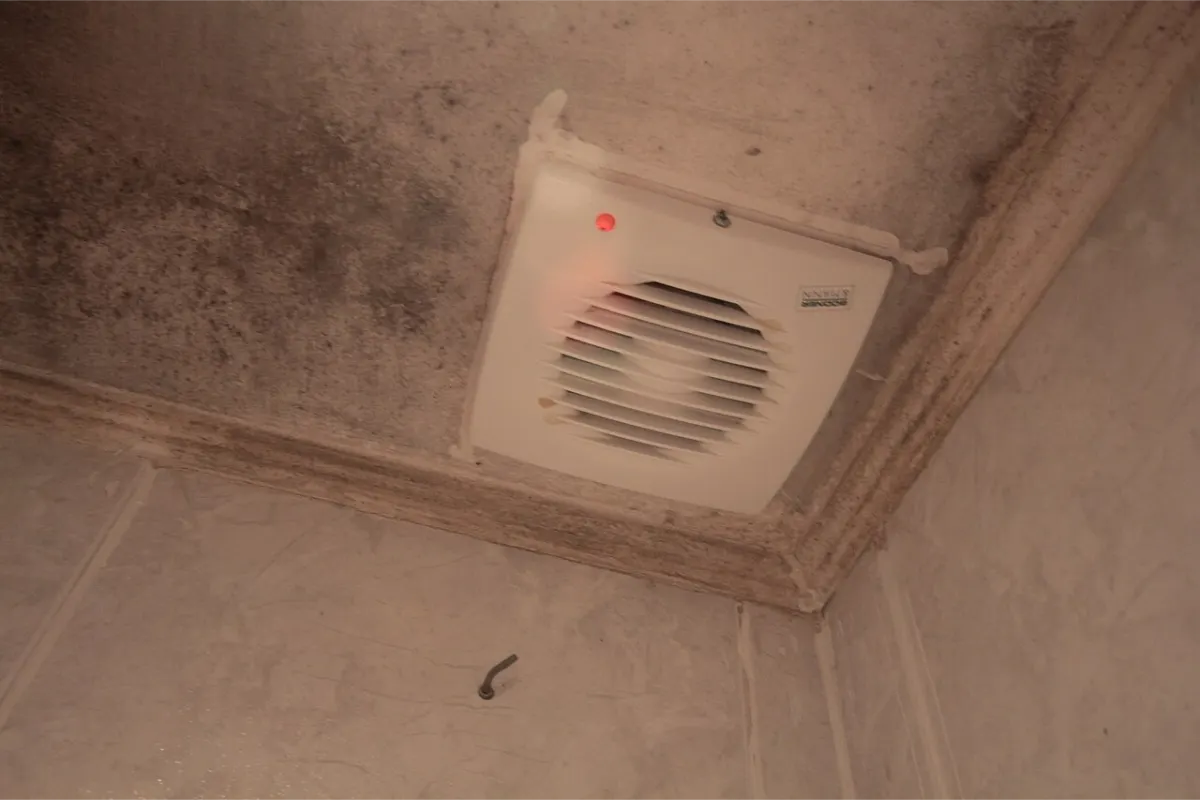
An exhaust that blows into a false ceiling does not remove the moisture; it moves the mould to the gypsum boards and the grid above.
Kitchen chimneys and exhausts
A kitchen chimney captures smoke, grease and steam at the hob. A ducted chimney blows them outside; a recirculating one filters them and returns the air to the kitchen, which removes some grease and smell but none of the moisture or heat. Wherever a duct to the outside is possible, ducted is better.
The duct should be as short and straight as possible, ideally under about three metres, with few bends, of the diameter the chimney maker specifies, and finished outside with a cowl that keeps out rain and birds. A duct squeezed flat to fit above the cabinets cuts the airflow badly. Clean the filters as the maker says; grease-clogged filters cut the extraction and are a fire risk. Where there is no chimney, a wall exhaust fan high near the hob, with a window or opening for replacement air, is the minimum.
Rooms and cross-ventilation
- Openings on two different walls wherever the layout allows, so air can cross the room.
- Windows that open, with ventilators or high openings above them for warm air to leave.
- Doors to inner rooms with a gap or a louvre, so air can move through the flat.
- Wardrobes on outside walls kept a little off the wall, with ventilation slots, so damp air does not stand behind them.
- Ceiling fans to keep air moving, which helps damp surfaces dry.
- Clothes dried on a balcony or near a window with a fan, not in a closed bedroom.
Air-conditioned rooms
Air-conditioning removes some moisture from the air, but a closed, air-conditioned room has little fresh air. With several people in it for hours, the air gets stale and carbon dioxide builds up, which makes people drowsy. A small amount of fresh air, by opening a window for a short time, a trickle vent, or a fresh air unit, keeps it comfortable.
Air-conditioned rooms next to humid spaces can also get condensation: cold walls, ducts and pipes sweat when humid air reaches them. Insulate the AC's refrigerant and drain pipes, seal where they pass through walls, and lead the condensate drain to a proper outlet, not down the outside wall.
Condensation and mould
Condensation appears when moist air meets a surface colder than its dew point: a bathroom ceiling under a roof, an outside wall in the corner of a bedroom, the back of a wardrobe, a window frame, a cold-water pipe. Mould follows wherever the surface stays damp for long. It is often confused with a leak or rising damp, but its signs differ: it appears where air is still and surfaces are cool, worse after cooking, bathing or sleeping with doors closed; our damp guide and the Damp Diagnoser help tell them apart.
To clear mould, wash it off with a fungicidal solution, let the surface dry, and fix the cause: more ventilation, less moisture, a warmer surface. Repainting with an anti-fungal paint helps only once the cause is fixed.

What to check
- Turn on each exhaust fan and hold a strip of tissue near it: it should be drawn firmly towards the fan.
- Check where each exhaust duct ends: outside, not in a ceiling void or a closed shaft.
- Check doors to bathrooms have a gap or louvre.
- Check the kitchen chimney's duct route and its outside cowl.
- Look for mould on ceilings, corners, behind furniture and inside wardrobes, and note when it gets worse.
- Check that rooms with mould have somewhere for air to come in and go out.
Specifying it right
- Bathroom exhaust: 150–250 m³/h capacity, mounted high on the wet-area side, ducted to open air, with a 15–20mm door undercut for make-up air.
- Kitchen chimney: ducted beats recycling filters every time; keep the duct run short (<3m ideally), minimum bends, and a bird-proof external cowl.
- North-light or cross-ventilation: a room needs two openings on different walls for air to actually move; a single window ventilates poorly no matter the size.
- False-ceiling bathrooms: never dump exhaust into the plenum — the mold relocates to your gypsum grid.
Monsoon-proofing the habit
Kolkata's humid months make passive drying slow. Run bathroom exhausts on a 15-minute overrun after showers (timer switches cost little), and leave wardrobe shutters ajar in the wettest weeks — trapped humid air is what smells.
Questions people ask
Why does a bathroom ceiling grow black mould?
Usually because moisture from showers cannot escape: no exhaust, an exhaust venting into the ceiling, or no path for replacement air. Fix the ventilation, then clean and repaint.
Is a recirculating kitchen chimney enough?
It removes some grease and smell but none of the moisture or heat. A ducted chimney is better wherever a duct to outside is possible.
How big should a bathroom exhaust fan be?
Fan makers give airflow in cubic metres per hour; a small home bathroom usually needs about 150 to 250, ducted outside, with a gap under the door.
Why does a wardrobe smell damp in the monsoon?
Humid air standing against a cool outside wall. Keep the wardrobe a little off the wall with ventilation slots, open it on dry days and check the wall is not damp.
Do air-conditioned rooms need ventilation?
Yes, a little fresh air, or the air gets stale over hours. Open a window briefly, or fit a trickle vent or fresh air unit.
Is it condensation or a leak?
Condensation appears where air is still and surfaces are cool, and worsens after cooking, bathing or sleeping. Leaks follow pipes, rain or bathrooms above. Our damp guide helps tell them apart.
Red flags
- Exhaust fan venting into the false ceiling
- Chimney duct crushed to fit above cabinets
- Interior bathrooms with no exhaust at all
Pro tip
Recurring black mold on a ceiling despite cleaning usually means a ventilation or condensation design issue — an interior designer or MEP consultant can fix the cause, not just the stain.
Work it out: Room Ventilation Checker
Sources
- National Building Code of India 2016, Part 8 Building Services, Section 1 Lighting and Natural Ventilation (Bureau of Indian Standards) (withdrawn by BIS on 30 April 2026; replaced by the National Building Construction Standards 2026, SP 7:2026) (checked 15 Nov 2026)
- India Meteorological Department, climate of Kolkata (checked 15 Nov 2026)
- CPWD Specifications (ventilation and exhaust) (checked 15 Nov 2026)
Checked against these sources on the dates shown, pending our team’s sign-off.