House wiring — copper gauge, MCB sizing and what 'ISI' must mean
Residential circuits in copper: 1.5 sqmm for lights, 2.5 sqmm for 16A sockets, 4–6 sqmm for ACs and geysers. Each circuit protected by an MCB sized to the wire (not the appliance), the whole board behind an RCCB (30mA) that trips on leakage. Wire gauge and MCB rating must be decided together — a big MCB on a thin wire protects nothing.
The MCB is a fuse for the wire, not the gadget. Pairing a 32A breaker with a 2.5 sqmm wire is like setting a smoke alarm to go off only after the sofa is gone.
House wiring is buried in walls for twenty or thirty years and carries the risk of shock and fire every day of them. Three decisions decide whether it is safe: the size of copper wire for each circuit, the breaker that protects it, and the protection against leakage to earth that protects people. Get them right together and the wiring is quietly safe. Get one wrong, such as a large breaker on a thin wire, and the protection is only on paper.
This guide explains how a house's wiring is organised, sizing wires and breakers together, residual current protection and why it saves lives, earthing, what good cable and accessories look like, circuits for air-conditioners, geysers and kitchens, older wiring in Kolkata homes, testing and the certificate, and the warning signs. Our Electrical Load Estimator works out the load of your home, and our rewiring guide covers renewing old wiring.
How a house's wiring is organised
Power arrives from the supplier, CESC in most of Kolkata and WBSEDCL in much of the rest of the state, through the meter to the main switch and the distribution board. From the board, separate circuits run to the lights, the sockets, and to each large appliance such as an air-conditioner or a geyser. Each circuit has its own breaker, and the whole board, or groups of circuits, sits behind a residual current device.
The rules that apply are the Central Electricity Authority (Measures relating to Safety and Electric Supply) Regulations, 2023, and the Indian code of practice for electrical wiring, IS 732. The National Building Code of 2016, Part 8, covered electrical installations in buildings; BIS replaced it in 2026 with the National Building Construction Standards, whose Part D covers building services. Work should be done by a licensed electrical contractor, who tests it and gives a report.
Wires and breakers, sized together
A miniature circuit breaker, or MCB, protects the wire, not the appliance. It trips when the current is more than the wire can carry safely, before the wire overheats. So the MCB's rating must suit the wire's size and the way it is installed, and the wire must suit the load. A 32 A breaker on a 2.5 sq mm wire will let that wire overheat long before the breaker trips.
| Circuit | Usual copper size | Usual MCB |
|---|---|---|
| Lighting and fans | 1.5 sq mm | 6 to 10 A |
| Ordinary sockets (6 A and 16 A) | 2.5 sq mm | 16 A |
| Air-conditioner, geyser | 4 sq mm | 20 to 25 A |
| Kitchen power circuit, cooking appliances | 4 to 6 sq mm | 25 to 32 A |
These are common pairings for copper wire in conduit in a house. The licensed contractor sizes each circuit for its load, its length and how it is laid, as IS 732 describes. Never fit a bigger breaker because one keeps tripping; find out why it trips.
Residual current protection
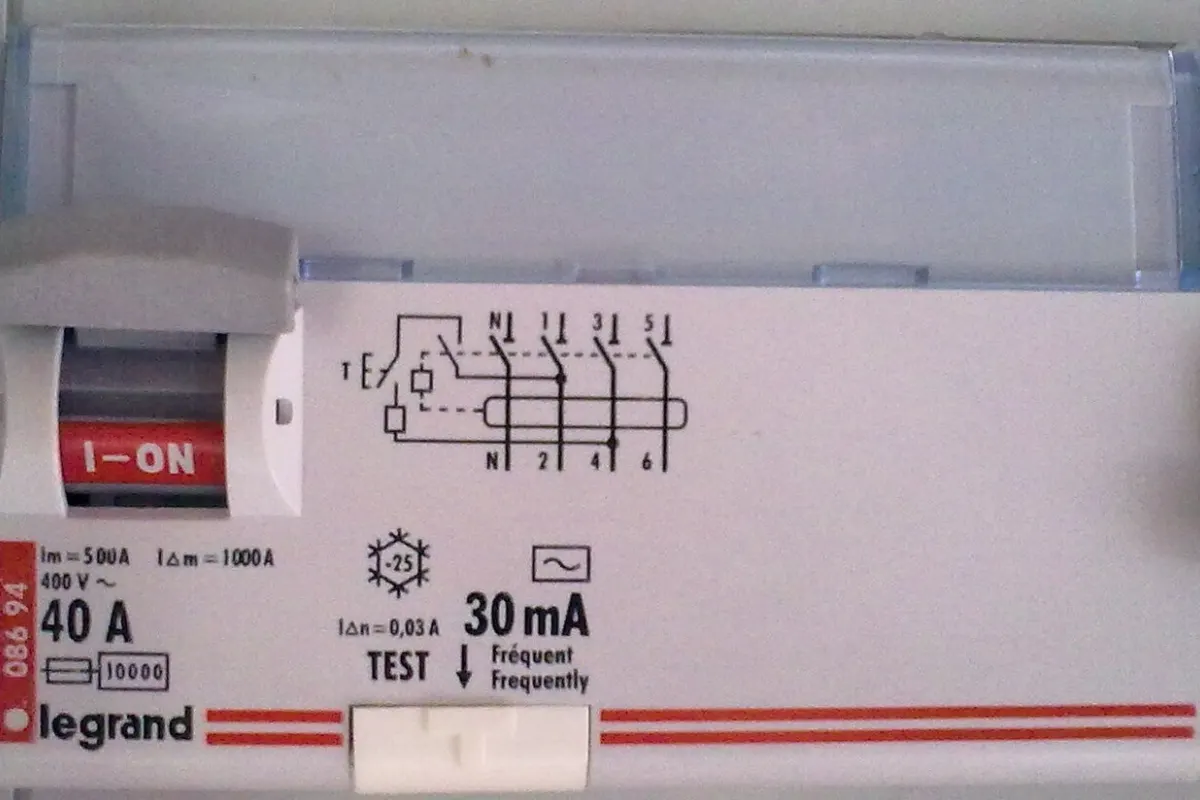
An MCB protects wires against overload and short circuits. It does nothing when current leaks to earth through a damaged appliance, a wet socket or a person. A residual current device, an RCCB or an RCBO, compares the current going out on the live wire with the current coming back on the neutral. If some is leaking to earth, it trips in a fraction of a second.
The Central Electricity Authority's 2023 regulations require residual current protection in installations, with a 30 mA device for the circuits people touch, such as sockets and bathrooms. A 30 mA device trips before a leakage current is likely to stop a heart. It is the device that saves lives; the MCBs save the wiring. Press its test button every month.

Earthing
Earthing gives leakage current a safe path to the ground, so that a fault trips the protection instead of making an appliance's metal body live. A house needs a proper earth electrode, made and tested as IS 3043 describes, connected by a protective conductor to every socket's earth pin, every metal appliance and the metal parts of the installation.
- Every three-pin socket actually connected to earth, checked with a tester, not assumed.
- The earth electrode tested, with its resistance recorded, and kept moist where the design needs it.
- Earth wires of the right size, green or green-and-yellow, never used as a neutral.
- Metal pipes, geyser bodies and pump casings bonded to earth where the rules ask.
- No 'earth' made by connecting to a water pipe or the neutral.
Good cable and accessories
- Copper cable to IS 694, with the maker's name, size, voltage grade and standard printed along the insulation, checked on the coil itself.
- Flame-retardant (FR) or flame-retardant low-smoke (FR-LSH) insulation for concealed wiring, which slows the spread of fire and gives off less smoke.
- Separate colours: red, yellow or blue for live, black for neutral, green for earth, so circuits can be traced later.
- A separate neutral for each circuit, taken back to the board, so each residual current device sees its own circuit.
- Conduits of the right size, not packed full, with draw boxes at bends so wires can be pulled out and replaced.
- MCBs, RCCBs and sockets from named makers with the ISI mark.
- Sockets of the right rating: 16 A sockets for heavier loads, never a 16 A appliance on a 6 A socket with an adaptor.
Air-conditioners, geysers and kitchens
Large loads need their own circuits. Each air-conditioner and each geyser should have a dedicated circuit from the board, with a wire and MCB sized for it and an isolating switch near it. Kitchens carry many appliances at once: a chimney, a microwave, an induction hob, a mixer, a kettle, a water purifier and a fridge. A kitchen fed from one ordinary socket circuit will trip or overheat. Give it its own circuit or two, and enough sockets above the counter, away from the sink. Our socket planning guide covers the numbers and heights.
Older wiring in Kolkata homes
Many older Kolkata flats and houses still have wiring from the 1970s, 1980s or earlier: rubber or old PVC insulation that has hardened and cracked, aluminium conductors, fuses instead of MCBs, no residual current protection, no earth wire to many sockets, and circuits extended again and again as air-conditioners and geysers were added. Humid air and the monsoon make old wiring and switchboards in damp walls more dangerous.
Signs that wiring needs attention include warm switches or sockets, a burning smell, flickering lights, breakers or fuses that trip often, sockets with no earth, and scorched plugs. Our rewiring guide explains how to plan a full rewire, often best done with other renovation work.
Testing and the certificate
- Before the walls are plastered, check the conduit routes and the boxes against the electrical layout.
- After wiring, the contractor tests insulation resistance between conductors and to earth, continuity of every earth connection, polarity at every socket and switch, and earth electrode resistance.
- The residual current devices are tested for their tripping current and time.
- Each circuit is labelled at the board.
- The contractor gives a test report, signed, with the values measured, and the layout of circuits.
- Keep the report and the layout with the house papers; the supplier, an insurer or a future buyer may ask for them.
Warning signs
- One large MCB feeding many mixed circuits.
- No residual current device in the board.
- Coils delivered with no maker, size or grade printed on the insulation.
- Shared neutrals between circuits, which make residual current devices trip for no clear reason.
- Sockets with no earth, or adaptors carrying air-conditioners and geysers.
- No test report at the end.
The pairing table
| Circuit | Copper size | MCB |
|---|---|---|
| Lighting | 1.5 sqmm | 6A |
| 5A/16A sockets | 2.5 sqmm | 16–20A |
| AC (1.5T) / geyser | 4 sqmm | 20–25A |
| Kitchen power run | 4–6 sqmm | 25–32A |
Board-level must-haves
- RCCB/ELCB 30mA on the whole house — this is the device that saves lives, MCBs only save wires.
- Proper earthing: every 3-pin socket actually connected to the earth bus, verified with a tester, not assumed.
- FR (fire-retardant) or FR-LSH insulation grade for concealed runs; check the print on the coil, not the carton.
- Separate neutral per circuit — borrowed neutrals make RCCBs trip mysteriously and are an electrician's shortcut to find later at your cost.
Questions people ask
What size wire is used for an AC?
Commonly 4 sq mm copper with a 20 to 25 A MCB on a dedicated circuit for a typical home air-conditioner, but the licensed contractor sizes it for the unit and the run.
What is the difference between an MCB and an RCCB?
An MCB protects wires from overload and short circuits. An RCCB detects current leaking to earth, through a fault or a person, and trips fast. A house needs both.
Is a 30 mA RCCB required?
The Central Electricity Authority's 2023 regulations require residual current protection, with 30 mA devices for the circuits people touch. It is the device that protects people from shock.
Why does a breaker keep tripping?
An overloaded circuit, a faulty appliance, a short circuit or, for a residual current device, leakage or a shared neutral. Find the cause; never fit a bigger breaker.
How often should earthing be checked?
When the wiring is installed, after any major change, and every few years, or sooner if sockets give tingles or residual current devices behave oddly.
Do you handle electrical work?
Yes, through licensed electrical contractors, who size the circuits, install them to the rules and give a test report.
Red flags
- One 32A MCB feeding many mixed circuits
- No RCCB in the distribution board
- Coils delivered without brand, size and grade printed on the insulation
Pro tip
For any rewiring or new AC load on an old flat, a licensed electrical contractor should compute the load and issue the test report — insurance claims after electrical fires turn on that paperwork.
Work it out: Electrical Load Estimator
Sources
- Central Electricity Authority (Measures relating to Safety and Electric Supply) Regulations, 2023 (checked 15 Nov 2026)
- IS 732 Code of Practice for Electrical Wiring Installations, and IS 3043 Code of Practice for Earthing (Bureau of Indian Standards) (checked 15 Nov 2026)
- IS 694 PVC Insulated Cables (Bureau of Indian Standards) (checked 15 Nov 2026)
- National Building Code of India 2016, Part 8 Building Services, Section 2 Electrical Installations (Bureau of Indian Standards) (withdrawn by BIS on 30 April 2026; replaced by the National Building Construction Standards 2026, SP 7:2026) (checked 15 Nov 2026)
Checked against these sources on the dates shown, pending our team’s sign-off.