Before the monsoon: what to fix on your roof, and when
Cracks, drain outlets and parapet joints cost less to fix in the dry months. A walk-round you can do yourself.
By Raj Sekhar Ghosh, Editor. Published 2026-11-20.
Key points
- Roof repairs need a dry surface. From November to February Alipore averages about 70 mm of rain in all; July alone averages 396 mm (IMD normals, 1981–2010).
- The monsoon normally reaches Kolkata around 11 June, and storms come before it: Alipore averages 133 mm of rain in May. Plan to finish roof work by the end of April.
- A stain on the ceiling shows where water comes out, not where it gets in. Find the way in before choosing a fix.
- Most leaks start at the details: the joint with the parapet, the rainwater outlets, pipes and supports through the roof, and places where water stands.
- A coating suits only a sound, dry roof with a good slope. A screed that is soaked through has to come out.
- Test the repair: pond water on it behind a temporary bund and watch the ceiling below for at least a day.
Why the dry months
Waterproofing sticks only to a dry surface. Coatings need a sound, dry base, membranes are laid on a dry screed, and a new screed needs dry days to set and cure before anything goes over it. In the monsoon most of this cannot be done; what can be done is temporary.
The India Meteorological Department’s normals for Alipore, worked out over 1981 to 2010, show the window. November averages 35.1 mm of rain, December 3.2 mm, January 10.4 mm and February 20.9 mm. May brings 133 mm in pre-monsoon storms, and the monsoon itself normally arrives around 11 June. Survey in the winter, repair by March, and leave April for the flood test and any touching up.
A walk-round you can do yourself
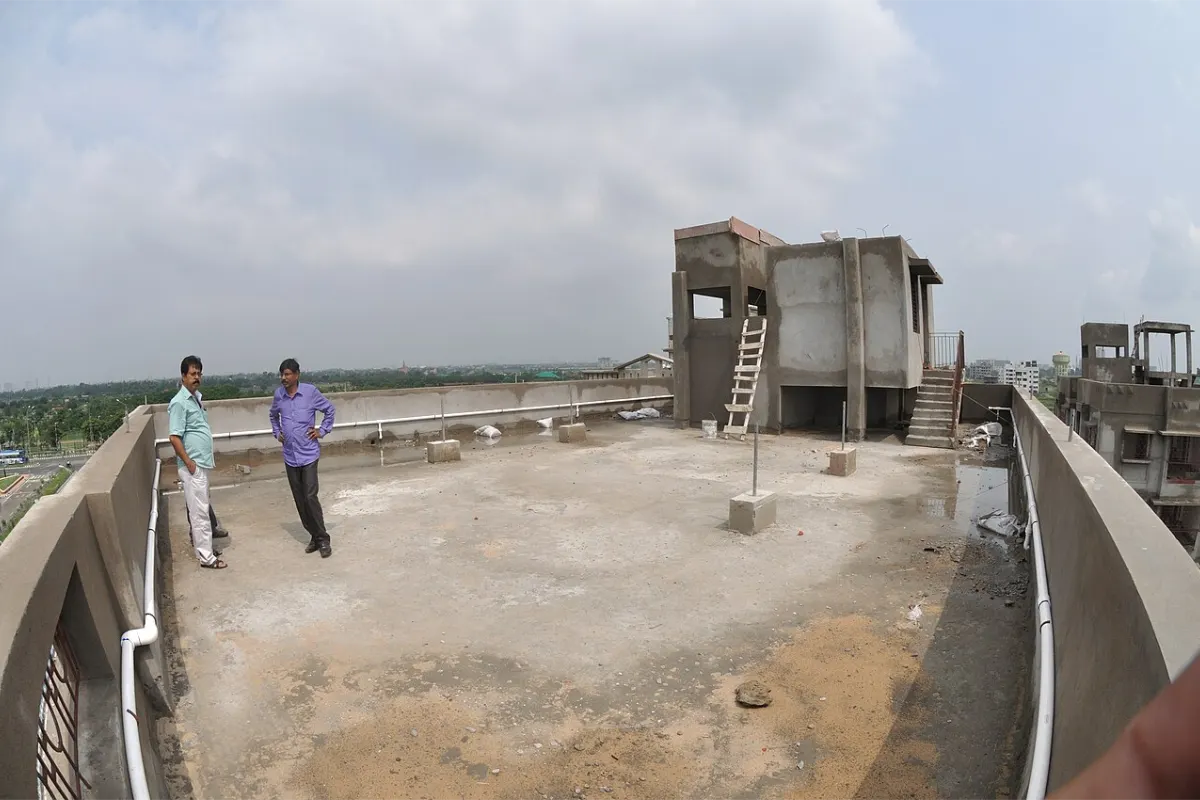
Go up on a dry morning, and again the day after any rain, if the roof is safe to walk on. Do not walk on an old lime terrace that sags or sounds hollow, and keep away from low parapets.
Look at where the roof meets the parapet: is the joint cracked or open, and does the waterproofing turn up the wall or stop at floor level? Look at each rainwater outlet: is it blocked with leaves, set higher than the roof around it, or loose where the pipe meets the slab? Look for places where water stands a day after rain, and for cracks in the screed, the tiles and the parapet top.
Look at everything that passes through the roof: pipes, cable entries, the water tank stand, antenna and solar panel fixings, the walls of the stair room. Each needs its own seal. Then go downstairs and map the ceiling stains, with the date you first saw each one. A stain that moves from storm to storm usually means water is travelling inside a soaked screed.
What the survey usually finds, and the fix that fits
One known crack on an otherwise sound, dry roof can be sealed and watched through one monsoon. Hairline cracks over a sound screed with a good slope suit a flexible coating over the whole roof, with the parapet and outlet details done as part of it. Wider cracks and open joints over a sound screed need a membrane system with its details.
When the screed or the brick bat coba under it is soaked, the slope has gone or the leaks keep moving, a coating on top will not hold: the lasting fix is to break out to the slab, repair it, lay a new screed to falls with a membrane, and finish it. An old lime terrace is repaired in lime, not sealed under cement; if its joists have rusted or rotted, an engineer designs the structural repair first. Our guide to waterproofing an old roof explains each treatment and how to read a quotation.
A timetable that beats the rain
November to January: the survey, the quotation and the decision, while there is time to compare. January to March: the repair, in dry weather. Before the finish goes on, a flood test: water ponded on the roof behind a temporary bund for at least a day, with the ceiling below watched. April: clear every outlet and grating, check the parapet joints, and fix anything the test found.
If a leak shows up only once the rains have started, clear the outlets, seal the worst cracks and cover the area that leaks, then book the real repair for the dry months. And plan any new solar frame or tank stand with the waterproofing: many good repairs are spoiled later by a bolt driven straight through the membrane.
What this means for you
- Your top-floor ceiling was stained last monsoon: have the roof surveyed this winter, while it is dry enough to test.
- Your roof was coated some years ago: check the coating now and recoat it before it wears through.
- Planning solar panels or a new tank stand: plan their supports with the waterproofing, not after it.
- Getting quotes: ask what happens to the old layers, how the parapet and outlets are detailed, and whether a flood test is included.
Sources
- India Meteorological Department: Kolkata (Alipore) climatological table, 1981–2010 (checked 2026-11-15)
- India Meteorological Department: new normal dates of monsoon onset and withdrawal (press release, 2020) (checked 2026-11-15)
- IS 1346 Code of Practice for Waterproofing of Roofs with Bitumen Felts (Bureau of Indian Standards) (checked 2026-11-15)
- CPWD Handbook on Repair and Rehabilitation of RCC Buildings (checked 2026-11-15)
Check it yourself
- Monsoon Check: Is your house ready for the rains? Tick the checks as you go, then run our storm over it.
- Waterproofing an old roof: The treatments ranked honestly, the details that decide the result, and how to read a quotation.

